
⚡ TL;DR: best eyebrow tools
Most brow routines need only three physical tools: a slant-tip tweezer for obvious strays, compact brow scissors for long hairs, and a spoolie or angled brush for grooming and product control.
A razor, powered trimmer, or stencil is helpful when it solves a specific recurring job, but none is an automatic must-have.
Top Picks
- 🏆 Best Overall — Tweezerman Slant Tweezer — precise everyday hair removal
- 🥈 1st Runner-up — Tweezerman Brow Scissors & Brush — controlled trim-and-comb set
- 🥉 2nd Runner-up — Anastasia Brush 12 — precise apply-and-blend control
The best eyebrow tools are not interchangeable, and that is exactly what makes shopping for them easier once we stop treating “brow tool” as one category.
Here, we focus on physical implements instead of pencils, gels, pomades, or powders, then matches each tool to the job it actually solves.
Start with the reversible move—brush and inspect—before reaching for scissors, tweezers, or a razor that changes the shape more decisively.
✨ Inside This Brow Guide
🌸 Psst…
Some links in this post are affiliate links. If you shop through them, we may earn a small commission at no extra cost to you — like a little coffee while we keep testing beauty favorites. ☕💄
Quick Comparison: Best Eyebrow Tools
Want the fast route?
We narrow the list by decide what we are trying to change: stray hairs, excess length, product placement, surface fuzz, coarse growth, or repeatable shape.
The table keeps those jobs separate so we can skip tools that do not match our routine.
| Tool | Best For | What It Does Differently | Main Trade-Off |
|---|---|---|---|
| Tweezerman Slant Tweezer | Isolated stray hairs | Removes hair from the root | Grip feedback is mixed |
| Tweezerman Brow Scissors & Brush | Long brow hairs | Shortens one hair at a time | Sharp tip needs careful handling |
| Anastasia Brush 12 | Pomade or powder control | Angled placement plus spoolie blending | Bristle firmness feels variable |
| JAPONESQUE Brow Touch Up Razors | Fine surface hair | Shaves close to skin level | Small blade is not for broad areas |
| Remington Eyebrow Trimmer | Coarse or long growth | Guarded powered trimming | Fine precision is less consistent |
| e.l.f. Eyebrow Stencil Kit | Repeatable outline guidance | Provides four reusable shape templates | Fit and positioning can take practice |
Which Eyebrow Tool Do You Actually Need?
A practical brow kit starts with the job.
Not the product count.
If we are blending hairs or softening makeup edges, a spoolie is enough. if we are placing pomade or powder, an angled brush adds control.
If a hair is clearly outside the shape, a tweezer removes it from the root, while scissors only shorten hair that belongs in the brow but has grown too long.
Razors solve a different problem again.
They remove fine surface hair quickly, so they can clean above, below, or between the brows without doing the same root-removal job as tweezers.
A powered trimmer is mostly a convenience option for longer or coarser growth, particularly when a guard or comb makes manual trimming feel awkward.
Stencils sit at the least permanent end of the shaping spectrum because they guide where product goes instead of cutting or pulling hair.
So they can be helpful for repeatability, but the template still has to make sense with our natural brow growth instead of forcing a predetermined shape.
Our simplest rule is brush first, then remove only what still looks obviously out of place.
A spoolie can reveal that a “stray” hair is really just lying in the wrong direction, and it can show which long hairs actually extend beyond the brow before scissors come near them.
Good lighting matters.
That is because the cost of a mistake rises as we move from brushing to trimming, tweezing, or shaving.
We prefer a conservative sequence: comb, reassess, isolate one problem hair or area, make one controlled change, then step back before continuing.
Angled brushes and spoolies can vary more than they look at first glance, particularly in firmness and head shape.
A brush-only guide gives those details the room they deserve.
Powered brow trimmers vary in guard style, cutting head, and how much fine control they offer.
So the broader comparison helps if a motorized tool is the category we actually need.
The Best Eyebrow Tools for Six Different Jobs
These six picks are not six versions of the same solution.
Each earns its place by handling a distinct brow task, so the strongest choice is the one that matches what we repeatedly need to fix—not the tool with the longest feature list.
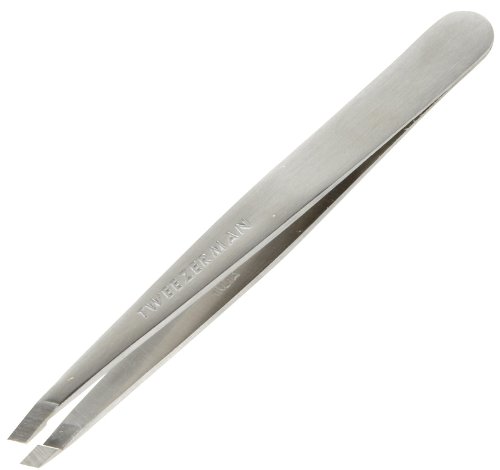
Tweezerman Slant Tweezer
A strong fit for Everyday Precision
A precision slant-tip tool for removing obvious strays without changing more brow than we intended.
A 25-degree slant tip gives this manual tweezer enough surface to catch ordinary brow hairs while still letting the high edge work on shorter, more precise targets.
That balance makes it a practical starting point if our routine is mostly about removing a few obvious strays instead of redesigning the whole brow.
Reviews frequently praise the finish, precise edges, and ability to catch fine hairs.
Grip is more mixed, though, so this is not a promise that every tiny hair will release cleanly on the first attempt.
Bottom line: A strong fit for deliberate stray-hair cleanup. We’d pick it when we want root removal with controlled placement, but stop once the obvious outliers are gone.
- ✅ Slanted edge balances broad grip with targeted precision
- ✅ Reviewers often like finish quality and fine-hair plucking
- ✅ Steel construction keeps cleanup simple between uses
- ✅ Edges are frequently described as staying sharp over time
- ❌ Grip may feel inconsistent if very short hairs are difficult to catch
- ❌ The price may feel high if we only tweeze occasionally
- ❌ A sharp, precise tip can encourage overworking the shape if we do not pause and reassess
🧪 Lash Lab Notes — Dr. Rabeya (Dentist & Beauty Enthusiast)
For me, the slant shape is about balance: enough contact area for control, but still enough precision for obvious outliers. I would keep the tool clean and set a clear stop point before simple cleanup turns into reshaping.
- 💡 Editor’s Note: We keep coming back to this type of tweezer because it keeps the job simple: one tool, one hair, one deliberate decision. The mixed grip feedback is worth knowing, but it does not erase the core advantage of a well-aligned slant tip for routine maintenance.
Want a last check? See current buyer feedback for the Tweezerman Slant Tweezer before deciding if the premium is worthwhile.
A strong fit for routine brow shaping when we want targeted root removal instead of surface shaving.
Care tip: Tweeze in the direction of growth, clean the tips after use, and store them dry.
Tip shape changes how a tweezer feels on tiny hairs, and a dedicated roundup makes those differences easier to compare.
It is particularly helpful if we are deciding between general slant tips and more specialized shapes.
Next, trimming makes more sense when the problem is length instead of a hair growing outside the brow.
Tweezerman Brow Shaping Scissors & Brush
A strong fit for Controlled Trimming
A compact scissor-and-brush pairing built for shortening long hairs one at a time.
Long brow hairs can make a tidy shape look uneven even when every hair is technically growing in the right place.
The helpful part of this set is not just the ultra-thin stainless-steel scissors. The brow brush matters too because it helps us lift hairs first and spot which ends actually need shortening.
That brush-first sequence supports a slower, more controlled trim.
The manufacturer guidance to isolate and cut one hair at a time also fits the way we prefer to approach brow scissors: make the smallest change that solves the length problem, then check again.
Bottom line: A controlled trim-and-comb pairing. It fits brows with a few overlong hairs, but the exposed sharp tip deserves careful handling near the eye area.

- ✅ Compact brow-specific blade shape helps with close visual control
- ✅ Included brush makes it easier to spot hairs that extend past the desired line
- ✅ Reviewers commonly like sharpness and trimming precision
- ✅ Stainless-steel blades are simple to clean
- ❌ The exposed pointed tip benefits from deliberate storage and handling
- ❌ Scissors do not remove true stray hairs from the root
- ❌ Cutting too many brushed-up hairs at once can shorten the brow more than intended

🧪 Lash Lab Notes — Fauzia (University Student & Beauty Enthusiast)
I like the included brush as a built-in check because it shows which hairs are actually too long before we cut. That quick extra look keeps the goal on tidy length instead of accidentally carving a new shape.
- 💡 Editor’s Note: The appeal here is control instead of speed. We’d rather make three tiny cuts with a brow-specific scissor than one broad snip that creates a flat or patchy top line.
Before we decide, check current availability for the Tweezerman Brow Scissors & Brush if trimming is the step our routine keeps needing.
We’d pick it for long or unruly brow hairs that need shortening without root removal.
Care tip: Brush hairs upward, trim one hair at a time, then clean and dry both tools after use.
Brow-specific scissors differ in blade shape, handle design, and control, which matters more than an all-purpose pair might suggest.
A focused comparison is the better next stop if trimming is our main recurring job.
Once length is under control, a dual-ended brush handles the more reversible job of placing and softening brow makeup.
Anastasia Beverly Hills Brush 12
A strong fit for Apply-and-Blend Control
A dual-ended application tool that places brow color with an angled tip and blends it with a spoolie.
This is the tool we consider when our brow routine uses pomade, cream, or powder and we want one handle for both placement and blending.
The tapered angled end is designed to lay down product with control, while the spoolie on the opposite side lets us soften edges and groom hairs right away.
That two-ended format is the real efficiency gain.
Reviews are positive about shaping and use with dip-style products, although bristle firmness is subjective and durability feedback is not uniformly strong.
Bottom line: A strong fit when makeup placement matters. It combines angled application and spoolie blending well, but the value depends on whether we will actually use both ends regularly.

- ✅ Angled synthetic fibers support controlled brow-product placement
- ✅ Spoolie blends edges without requiring a second tool
- ✅ Reviewers often like shaping performance with pomade-style products
- ✅ Dual-ended design keeps a two-step routine compact
- ❌ Bristle stiffness may feel too firm or too soft depending on preference
- ❌ Durability feedback is mixed instead of uniformly strong
- ❌ The price is harder to justify if we rarely use powder, cream, or pomade
🧪 Lash Lab Notes — Zayba (A-Level Student & Beauty Enthusiast)
What I like for beginners is the quick switch from placement to softening: use the angled end, turn the brush, then diffuse the edge. That can make a fast brow routine easier to control because the correction step is built into the same tool.
- 💡 Editor’s Note: We’d buy a dual-ended brow brush for workflow, not prestige. If we use pomade or powder several times a week, having both ends together is actually convenient. If we mostly use a pencil with its own spoolie, it may be redundant.
Want a last check? See recent customer feedback for the Anastasia Brush 12 before adding it to our routine.
A good fit for cream, pomade, or powder users who want definition and blending in one handle.
Care tip: Wash the reusable brush as needed, reshape the bristles gently, and let it dry fully.
For hair instead of makeup, a touch-up razor offers a faster surface-level option—but it solves a different problem from tweezing.
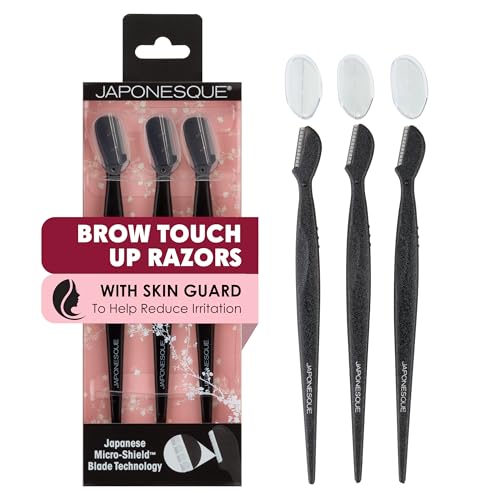
JAPONESQUE Brow Touch Up Razors
A strong fit for Fast Surface Cleanup
A small-area razor set designed for controlled surface-hair cleanup around the brows and face.
A small brow razor makes sense when the goal is fine surface hair around the outline, between the brows, or on another small facial area.
JAPONESQUE uses a short Japanese stainless-steel blade and non-slip handle in a three-piece set, which keeps the tool compact and easier to place than a broad face razor.
The distinction from tweezers matters: shaving removes hair at skin level instead of pulling it from the root.
That can make cleanup quick, but reviewer feedback on sharpness and irritation is mixed, so a light hand is more important than chasing the closest possible pass.
Bottom line: Fast cleanup for fine surface hair. Use it for small touch-up zones, not as an all-purpose replacement for tweezers or a broad facial razor.
- ✅ Short blade is well suited to small brow-area touch-ups
- ✅ Non-slip handle helps with controlled placement
- ✅ Three-piece set is convenient for rotation or travel
- ✅ Reviewers often like brow-sized precision and easy cleanup
- ❌ The small blade is inefficient for broad full-face shaving
- ❌ Sharpness may feel inconsistent from user to user
- ❌ Irritation or small cuts can occur if pressure or repeat passes get too aggressive
🧪 Lash Lab Notes — Dr. Sazia (Medicine Specialist & Beauty Enthusiast)
I see surface cleanup as useful only when the pressure stays gentle. I would keep the blade away from lashes and the eye itself, and I would stop if the skin is already irritated rather than repeat scraping.
- 💡 Editor’s Note: We treat this as a precision cleanup tool, not a shortcut for every grooming step. It earns a place when fine fuzz or quick edge cleanup is the actual problem, while a tweezer remains the more targeted choice for isolated hairs we want removed from the root.
Want another reality check? View current reviews for the JAPONESQUE Brow Touch Up Razors if surface cleanup fits our routine.
A strong fit for small facial areas where quick, controlled surface shaving is the goal.
Care tip: Hold skin taut, glide gently, clean and dry the razor after use, and replace it when dull.
If a brow razor is becoming a regular part of our routine, blade size and guard design are worth comparing instead of buying blindly.
The dedicated guide keeps that decision separate from tweezers and trimmers.
Readers dealing with longer or coarser growth may prefer a powered option with a comb instead of repeated manual snips.
Remington Nose, Ear & Eyebrow Trimmer
A strong fit for Guarded Powered Grooming
A guarded battery-powered detail tool for longer brow hairs and other facial grooming tasks.
A powered detail trimmer is most appealing when manual scissors feel slow or awkward on longer brow hairs.
The Remington Eyebrow Trimmer includes an eyebrow trimming comb alongside its other nose-and-ear attachments, plus a washable system designed to make cleanup easier.
That convenience comes with an important trade-off: a motor does not automatically create finer brow precision.
Buyer feedback is positive on handling and cleaning, but cutting performance, battery life, heat, and durability are mixed, so we would treat this as a convenience tool instead of the precision champion of the list.
Bottom line: A strong fit for guarded powered convenience. It can simplify coarse-hair maintenance, but manual scissors still offer more deliberate control for tiny corrections.

- ✅ Eyebrow comb gives a brow-specific trimming attachment
- ✅ Wet/dry design and CLEANBoost system support easy rinsing
- ✅ Multi-purpose attachments reduce the need for separate detail trimmers
- ✅ Many users find the body easy to hold and maneuver
- ❌ Cutting closeness and eyebrow performance receive mixed feedback
- ❌ Battery life and long-term durability are not consistently praised
- ❌ Some users report heat buildup during use
🧪 Lash Lab Notes — Engr. Nusrat (Engineer & Beauty Enthusiast)
I look at the eyebrow comb first because the guard controls how much length reaches the blade. That attachment is what makes a powered trimmer useful for brows; extra motor speed by itself does not equal extra precision.
- 💡 Editor’s Note: We’d choose this for convenience when long hairs are the recurring nuisance, particularly if the other detail-trimming attachments are helpful too. If our brow maintenance is only two or three exact snips, a compact scissor is simpler and gives us more visual control.
Before we decide, check today’s listing details for the Remington Eyebrow Trimmer before choosing the powered route.
A good fit for longer or coarser brows when a guarded, battery-powered tool feels easier than scissors.
Care tip: Use the correct comb or attachment, rinse through the cleaning system as directed, and let it dry.
The final pick does not remove hair at all. use it when we want a repeatable guide before filling.
e.l.f. Eyebrow Stencil Kit
A strong fit for Repeatable Shape Guidance
A four-template reusable guide for making filled-in brow shapes easier to repeat.
A stencil can be helpful when the frustrating part of brow makeup is repeating a similar outline on both sides.
The e.l.f.
Eyebrow Stencil Kit includes four reusable shapes—Curved Arch, Soft Arch, Structured Arch, and Full Arch—so we can test a few guides instead of committing to one fixed template.
The limitation is fit.
Reviews are positive about shape variety and helpfulness, but sizing and ease of positioning are mixed, which is exactly why we see a stencil as a guide instead of a rule for what our face “should” look like.
Bottom line: Useful for repeatable guided filling. It can make shape placement easier, but only when one of the templates works with our natural brow instead of fighting it.

- ✅ Four reusable arch options provide meaningful shape variety
- ✅ Templates can make repeated pencil or powder placement more consistent
- ✅ Reusable format keeps the tool simple and low-maintenance
- ✅ Reviewers often value the guidance and overall build quality
- ❌ Some templates may feel too large for smaller natural brows
- ❌ Positioning can take practice without an adhesive or holder
- ❌ A stencil cannot personalize itself to our growth pattern or preferred finish
🧪 Lash Lab Notes — Mahmuda (Homemaker & Beauty Enthusiast)
I would choose the stencil that sits naturally over the brow with the least adjustment. I treat the template as a repeatability aid, then soften or adapt the result instead of forcing every edge to match it exactly.
- 💡 Editor’s Note: We keep coming back to stencils most for consistency, not transformation. If one shape helps us place product faster on busy mornings, the kit has done its job. If every template needs constant repositioning, a simple mapping approach may suit us better.
Want a last check? See current customer feedback for the e.l.f. Eyebrow Stencil Kit if guided shaping sounds helpful.
A strong fit for beginners or routine users who want reusable help placing a consistent brow outline.
Care tip: Align the closest-fitting shape with our natural brow, flip it for the other side, then clean it after use.
With all six roles clear, the easiest way to avoid overspending is to build a kit around frequency instead of possibility.
The Minimal Brow-Tool Kit: What to Buy First and What to Skip
For most people, the baseline kit is a slant-tip tweezer, compact brow scissors, and a spoolie or dual-ended angled brush.
Those three cover isolated strays, excess length, and grooming or blending—the recurring maintenance jobs that show up in the widest range of routines.
A razor earns a place when fine surface fuzz is a regular concern.
A powered trimmer makes more sense when coarse or long hairs repeatedly make manual trimming tedious, while a stencil is optional guidance for someone who wants help repeating a filled-in outline.
The best brow-tool kit is modular: buy for the task we actually repeat every week.
That keeps a “complete” kit from turning into a drawer of sharp or specialized tools we rarely use.
If we use wooden brow pencils, a sharpener can also matter because a clean point changes application control.
It is an accessory branch, though, not a universal grooming essential.
Wooden-pencil users have a different maintenance need from readers using twist-up formulas.
If that is part of our routine, a dedicated sharpener guide helps us compare compact options without expanding this grooming roundup into cosmetics.
And if the physical tools are already sorted, the next shopping decision may be formula instead of hardware.
That broader guide covers pencils, gels, and other products that this tool-focused article deliberately leaves out.
We do not need to own one item from every row of the comparison table.
Start with the three-tool baseline, then add only the razor, powered trimmer, stencil, or sharpener that solves a repeatable problem our current kit cannot.
Brow Tool Questions You’re Probably Still Asking
A few tool choices become much easier once the removal method and order of operations are clear.
These answers keep the maintenance logic simple without turning a buying guide into a full grooming tutorial.
❓ Which is better for eyebrows: a razor or tweezers?
Neither is universally better because they remove hair differently.
Tweezers pull an isolated hair from the root, while a brow razor cuts surface hair at skin level, so the choice depends on whether we are targeting a specific stray or quickly cleaning fine fuzz around the outline.
If tweezing is the job, technique matters just as much as tip shape because repeated removal can change the brow faster than expected.
The dedicated tutorial covers the actual plucking sequence and stop points in more detail.
❓ Do you need a spoolie before trimming eyebrows?
We do not need a particular branded spoolie, but brushing the brow first is a smart control step because it reveals which hairs actually extend beyond the shape.
Once the hairs are lifted, trim only the obvious excess instead of cutting a straight line across everything that stands up.
A full trimming guide is more helpful than squeezing the technique into a product review, particularly if we are unsure where to cut or when to stop.
It keeps the focus on controlled length instead of simply owning scissors.
❓ How should you use an eyebrow razor around the brow line?
Use the razor only for the small surface-cleanup job it is designed to do, follow the product’s handling instructions, and avoid repeated scraping over irritated skin.
Keep the blade away from the eye and lashes, and use a light, controlled pass instead of trying to force an ultra-close result.
Razor angle, skin tension, and working direction deserve a step-by-step explanation when we are new to the tool.
That technique belongs in the dedicated razor tutorial instead of being compressed into this roundup.
❓ How often should eyebrow tools be cleaned?
There isn’t one universal interval supplied for every tool in this guide, so follow the manufacturer’s care directions and clean reusable tools whenever residue, hair, or skin contact makes it necessary.
Tweezers, scissors, razors, brushes, and powered attachments all have different materials and mechanisms, which is why the product-specific care guidance matters.
At the very least, avoid putting a visibly dirty tool back into our brow routine.
Dry metal tools and reusable brush heads thoroughly after cleaning, and replace disposable or dull blades instead of pushing them past helpful condition.
Stencils or Mapping Tools: Which Guidance Method Fits?
These two solve different problems.
A stencil gives us a reusable shape boundary for filling, while a measuring or mapping tool helps establish reference points and symmetry. We may prefer the simpler option that addresses the part of shaping we find hardest.
Threading is another specialist option, but technique proficiency matters more than owning a particular thread product.
For a home tool kit, it is reasonable to start with the simpler grooming and guidance tools here instead of treating every professional method as mandatory.
Stencil-only roundups are helpful when we want to compare shape ranges and positioning styles instead of one starter kit.
That is the next step if templates are the tool category we know we want.
A stencil guides a visible outline, while mapping tools focus more on measuring reference points and symmetry.
That difference matters if our main problem is placement instead of choosing a reusable arch template.
Final Thoughts: Build the Kit Around Your Brows
The best brow kit is not the one with the most pieces.
It is the one that matches the jobs our brows keep asking us to do: brush and blend first, remove an obvious stray when needed, shorten a long hair carefully, and add a specialized razor, powered trimmer, or stencil only when that task repeats often enough to justify it.
That brings us back to the opening idea: brow tools are not interchangeable, and they do not need to be.
We buy the tool for the job we repeat, not every tool in the category.
Once our brow-specific setup is covered, we can widen the same job-first logic to the rest of our routine.
The broader guide helps connect brow tools with applicators and grooming essentials used elsewhere around the eyes.
Last update on 2026-10-10 / Affiliate links / Images from Amazon Product Advertising API