⚡ TL;DR: best prostaglandin-free eyelash serum
What matters most? A current formula we can clearly verify as prostaglandin-free. Its claims should also match the evidence behind them, and the routine needs to be realistic enough to follow consistently.
Cosmetic peptide and conditioning serums can support fuller-looking lashes. They should not be treated as equivalents to prescription bimatoprost.
Top Picks
- 🏆 Best Overall — The Ordinary Multi-Peptide Serum — verified formula, standout value
- 🥈 1st Runner-up — OLAPLEX LASHBOND Serum — premium peptide story, useful evidence
- 🥉 2nd Runner-up — VEGAMOUR GRO Lash Serum — plant-based peptide focus
Shopping this category looks simple. Then we notice how many products share nearly identical names.
The best prostaglandin-free eyelash serum needs a clearly identified current formula and believable cosmetic expectations. Even products in one brand family can use different active approaches.
So how did we rank them? Formula clarity came first. Then we weighed evidence quality, routine fit, comfort considerations, and value.
✨ Inside This Lash Guide
🌸 Psst…
Some links in this post are affiliate links. If you shop through them, we may earn a small commission at no extra cost to you — like a little coffee while we keep testing beauty favorites. ☕💄
Quick Comparison: Best Prostaglandin-Free Eyelash Serum
Where should we start? With the formula class. Then the routine and evidence columns help separate products that otherwise sound very similar.
None of these cosmetic options should be judged by whether it can mimic a prescription drug.
| Product | Formula approach | Application rhythm | Evidence signal | Best fit |
|---|---|---|---|---|
| The Ordinary Multi-Peptide Serum | Peptides + conditioning blend | Twice daily | Brand claims + user feedback | Value-focused routine |
| OLAPLEX LASHBOND Serum | Peptide-focused conditioning | Twice daily | Small brand study | Premium routine |
| VEGAMOUR GRO Lash Serum | Peptides + phytoactives | Twice daily, then maintenance | Small brand study | Plant-based preference |
| GrandeLASH-Sensitive | Peptide-based sensitive variant | Follow current directions | Variant-specific brand support | Sensitive-formula shoppers |
That table makes one thing clear: “prostaglandin-free” is only the first filter.
What comes next? We separate clear formula identity from louder growth language.
How We Chose Prostaglandin-Free Lash Serums
First question: does the exact current product or variant have support for being prostaglandin-free? That was the keyword-defining requirement.
Why so strict? A 2026 analysis indexed by PubMed/NIH examined 79 cosmetic eyelash-lengthening serums. It found prostaglandin analogues in roughly 30% of them. Non-prostaglandin formulas used approaches such as peptides, amino acids, panthenol, and conditioning ingredients.
Next, we looked for a formula story we could actually recognize. Practical application directions mattered too.
Claims also had to stay in proportion. Cosmetic appearance benefits should not quietly become guaranteed biological growth.
Routine burden matters in real life. A serum that asks for perfect twice-daily consistency fits differently from one we can comfortably maintain. User feedback helped us judge that practical side.
What mattered more than a dramatic promise? Formula transparency.
A prostaglandin-free label does not prove a serum will work for everyone. It also does not make irritation impossible. It simply keeps the product inside the ingredient-avoidance boundary of this roundup.
Want the mechanism before the product list? The broader explainer separates conditioning, appearance claims, and active approaches. That makes the trade-offs below easier to judge without expecting every formula to behave the same way.
With that filter in place, hype matters less. The real question becomes which formula-and-routine combination fits us best.
Best Prostaglandin-Free Eyelash Serums
These four picks all meet the article’s prostaglandin-free requirement. They simply serve different priorities: value, premium peptide positioning, plant-based formulation preferences, and sensitive-variant shopping.
Does first place promise the best result for every person? No. The order reflects overall fit for this specific ingredient-avoidance search.
The Ordinary Multi-Peptide Lash and Brow Serum
Best Overall
Want the simplest all-around starting point? This lightweight lash-and-brow formula makes a strong case with clear prostaglandin-free positioning and no premium just for the category label.
The formula story is easy to follow. The Ordinary Multi-Peptide Serum combines peptides, plant extracts, caffeine, amino acids, and conditioning ingredients in a water-based serum.
It is meant to support denser-, fuller-, and thicker-looking lashes and brows. Current product information also explicitly identifies the formula as prostaglandin-free. That removes one of this category’s biggest uncertainties.
The bigger win is expectation-setting. The brand describes visible cosmetic improvements after about four weeks with continued twice-daily use.
What do users say in the product record? Feedback leans gradual rather than dramatic. That fits a cosmetic serum more credibly than language suggesting prescription-like growth.
Bottom line: Our best-balanced pick combines clear formula identity, accessible positioning, and an easy dual-purpose lash-and-brow routine, as long as gradual results work for us.

- ✅ Formula is explicitly positioned as prostaglandin-free
- ✅ Texture is lightweight and quick-drying
- ✅ One serum covers both lashes and brows
- ✅ Value compares well with premium serums
- ❌ Not a fit when we expect fast or prescription-strength results
- ❌ Harder to justify if twice-daily use will not fit our routine
- ❌ Skip if lash-line products leave our eyes gritty or irritated

🧪 Lash Lab Notes — Fauzia (University Student & Beauty Enthusiast)
For me, the practical part is where a twice-daily serum fits. Keeping it beside morning and evening skincare adds less friction. That matters because consistency is likely to shape satisfaction more than dramatic marketing language.
- 💡 Editor’s Note: This is our default starting point because the formula identity is unusually easy to verify. The routine is simple too. If we want a prostaglandin-free cosmetic serum rather than a drug-like effect, slower and subtler change is a reasonable trade-off.
Wondering how current buyers feel about that routine? Read feedback for The Ordinary Multi-Peptide Serum.
This is the pick when we want a clear, value-forward formula and can use it consistently.
Care tip: Use a thin layer on clean, dry skin. Let it absorb before other products, and stop if irritation persists.
That value-first profile gives us a useful baseline. Next comes a different question: is premium peptide positioning worth the extra step?
OLAPLEX LASHBOND Building Serum
Best Premium Peptide Option
Prefer a more polished routine? This peptide-focused serum is the premium option when ophthalmologist-tested positioning and brand-supported performance data matter more than bargain pricing.
OLAPLEX describes the formula as prostaglandin-free. It positions the serum around the look of lifted, longer, denser, thicker lashes.
The formula story is specific too. Current brand information highlights peptide technology with red clover, hyaluronic acid, biotin, and panthenol. That says more than a vague “growth serum” label.
Now, the evidence needs proportion. The cited performance claims come from a 12-week consumer-perception study of 33 subjects.
So what does that mean? We treat it as a useful brand signal, not independent clinical proof. Product-record feedback is also mixed on visible results and value.
That is why the premium price should buy us a routine we genuinely prefer. It should not buy certainty.
“Ophthalmologist-tested” sounds reassuring, but what does it actually tell us? It does not mean a lash serum is guaranteed to work or cannot irritate the eyes. Our terminology guide explains the reasonable meaning before we use that phrase as a buying signal.
Bottom line: This is our stronger premium pick for clear prostaglandin-free positioning and a peptide-led formula, while the small brand study and mixed feedback keep expectations measured.

- ✅ Formula has explicit prostaglandin-free positioning
- ✅ Peptides sit at the center of the formula story
- ✅ Brand uses ophthalmologist-tested positioning
- ✅ Upper-lash-line application is straightforward
- ❌ Poor fit when value comes first
- ❌ Not for us if we expect a small brand study to predict personal results
- ❌ Easy to skip when a twice-daily step already feels like too much
🧪 Lash Lab Notes — Engr. Nusrat (Engineer & Beauty Enthusiast)
For me, the useful detail is the repeatable sequence: one dip, upper lash line, then a short dry time. The real question is whether that twice-daily step fits neatly between skincare and eye makeup.
- 💡 Editor’s Note: We would pay more only if the application experience and peptide-focused positioning matter enough to us. The evidence story is more concrete than pure marketing copy, but it is still brand-generated. We should read it that way.
Need another perspective before committing? Compare current feedback on OLAPLEX LASHBOND Serum.
This suits us when premium routine design matters as much as formula class.
Care tip: Apply it to a clean, dry upper lash line. Let it dry before layering eye products.
Not interested in premium positioning alone? A plant-based formula story gives us a different reason to spend more.
VEGAMOUR GRO Lash Serum
Best Plant-Based Approach
Want peptides plus plant-based phytoactives? This lightweight option fits best when vegan and cruelty-free product positioning also matters to us.
The current formula is identified as prostaglandin-free. Its formula story centers on peptides and phytoactives.
Supplied product data also describes a lightweight, non-greasy texture. It excludes several ingredient classes such as parabens, phthalates, silicones, and sulfates.
But do those “free-from” claims prove better lash performance? No. They describe formula choices, not stronger results.
The brand cites a 60-day study of 30 participants. That helps us understand its own claims, but it is still a small brand study.
Real-world feedback is mixed on visible change, value, and eye-area comfort. So this pick makes more sense for formula preference and routine fit than for any assumption that plant-based automatically means gentler or stronger.
Bottom line: This is our best match for a plant-based peptide approach, while the small brand study and mixed feedback make it a preference-led choice rather than a certainty-led one.

- ✅ Formula carries explicit prostaglandin-free positioning
- ✅ Peptides and phytoactives define the formula approach
- ✅ Texture is described as lightweight and non-greasy
- ✅ Product positioning is vegan and cruelty-free
- ❌ Not ideal when our priority is the lowest cost
- ❌ Wrong fit if we treat plant-based as irritation-proof
- ❌ Not the choice when we require independently proven finished-product results
🧪 Lash Lab Notes — Mahmuda (Homemaker & Beauty Enthusiast)
For me, the routine gets more appealing because it begins more intensively and can later become easier to maintain. That may help when twice-daily use feels heavy long term. Comfort still depends on our own eye area; “gentle” or plant-based wording cannot predict individual tolerance.
- 💡 Editor’s Note: We see this as a formula-preference pick, not a universal upgrade over cheaper serums. If vegan, plant-based positioning matters to us, the story is coherent. If it does not, the mixed value feedback deserves more weight.
Want a wider view of everyday experiences? Browse feedback on VEGAMOUR GRO Lash Serum.
This makes sense when plant-based positioning is a real priority, not just a nice-to-have.
Care tip: Apply only as directed around the lash line. Stop use if burning or persistent irritation develops.
The last pick changes the decision again. Now the issue is not formula philosophy; it is choosing the exact variant inside a familiar product family.
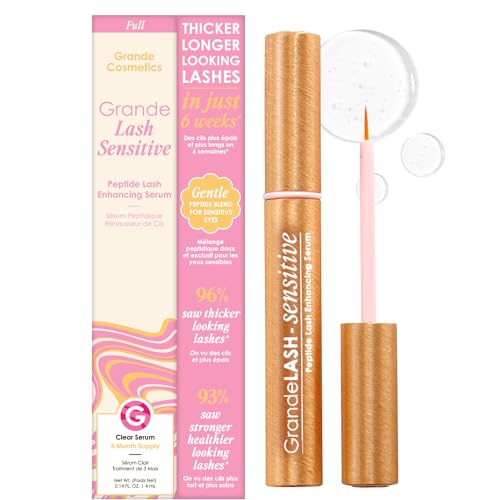
Grande Cosmetics GrandeLASH-Sensitive
Best Sensitive-Eye-Specific Option
Shopping by the GrandeLASH name alone? This is the variant-aware choice when we want a prostaglandin-free formula from Grande Cosmetics without assuming every product in that family uses the same active approach.
Current brand information identifies GrandeLASH-Sensitive as prostaglandin-free and peptide-based. That keeps this exact Sensitive variant inside the article boundary.
Why does the exact name matter so much? GrandeLASH-MD is a different formula that the brand identifies with a prostaglandin analogue. Shopping by family name alone can defeat the whole purpose of this search.
The supplied product record gives less detailed consolidated performance evidence for this exact variant than the other picks. So we do not treat sensitive positioning as a guarantee of comfort or superior results.
The value here is formula identity and variant fit. “Sensitive” does not mean reaction-proof.
Bottom line: GrandeLASH-Sensitive is the right Grande-family option for this prostaglandin-free search, but we still need to verify the exact Sensitive variant and current ingredient list instead of relying on the brand name.
- ✅ Exact Sensitive variant is identified as prostaglandin-free
- ✅ Formula uses peptide-based positioning
- ✅ Variant identity is clear for careful shoppers
- ✅ Product carries sensitive-skin positioning
- ❌ Risky when we shop by brand family without checking the exact variant
- ❌ Not the strongest fit if finished-product evidence is our main priority
- ❌ Skip if our eyes stay irritated despite sensitive-positioned wording
🧪 Lash Lab Notes — Dr. Sazia (Medicine Specialist & Beauty Enthusiast)
For me, the exact Sensitive variant is the key detail because the same brand family also sells a formula built around a prostaglandin analogue. Check the package and current ingredient list carefully. Stop use if the eye area becomes persistently irritated.
- 💡 Editor’s Note: This pick turns an abstract warning about variant names into a real shopping decision. We would not choose it simply because “Sensitive” sounds safer. We would choose it only after confirming the exact variant still matches the prostaglandin-free formula we intend to use.
Before we choose the Sensitive variant, check current feedback for GrandeLASH-Sensitive.
This is the fit when exact variant identity is our biggest source of uncertainty.
Care tip: Follow the current package directions. Keep the applicator out of direct contact with the eye.
These product tips are enough for comparing routines, but not for learning the full application process. Want the placement details? The step-by-step guide covers them when we are ready to use our chosen formula.
Once we separate the products by formula and fit, one question remains: what does the category label actually tell us?
What Prostaglandin-Free Actually Means
What does “prostaglandin-free” actually promise? Only the formula class. It means the formula is presented without prostaglandins or prostaglandin analogues.
It does not mean the serum is inactive. It also does not mean it is clinically equivalent to prescription treatment or incapable of causing irritation.
A 2024 review indexed by PubMed/NIH separates prostaglandin-analogue and non-prostaglandin lash serums. It notes that the formal evidence base is much stronger for bimatoprost than for cosmetic non-prostaglandin formulas.
That evidence gap changes how we read claims. Peptides, conditioning ingredients, and botanical components may support the appearance or condition of lashes.
But a cosmetic serum should not inherit bimatoprost’s evidence simply because both are sold for lashes.
Safety needs the same restraint. The U.S. Food and Drug Administration prescribing information for LATISSE/bimatoprost includes warnings and precautions involving iris pigmentation, eyelid/periorbital pigmentation, unwanted hair growth where the product repeatedly contacts skin, and other ocular considerations.
Why do some shoppers avoid prostaglandin-type actives? Those drug-label risks explain the choice. They do not prove every non-prostaglandin cosmetic serum will be comfortable for every eye.
Interested specifically in prescription treatment instead of cosmetic alternatives? Application technique belongs in a separate medical-use discussion. That guide handles the process directly without turning this shopping roundup into a prescription tutorial.
So the practical takeaway is not “prostaglandin-free equals risk-free.” It is simpler: know the formula class, then judge that exact product on its own evidence and tolerability.
How to Check a Lash Serum Ingredient List
Where do we start? With the exact current product name and variant, not the brand family.
Check the current ingredient list before buying or repurchasing, because formulas and variant lineups can change while familiar names stay on the shelf.
The 2026 analysis of cosmetic lash serums found several prostaglandin analogues in the market. Examples included ethyl tafluprostamide/DDDE and isopropyl cloprostenate.
If avoiding this class is our goal, headline claims are not enough. We need to look for specific prostaglandin-analogue names rather than assuming “conditioning,” “peptide,” “natural,” or “sensitive” wording settles the question.
A practical screen looks like this:
- Match the package to the exact variant name we researched.
- Read the current ingredient list instead of trusting an old roundup or cached product page.
- Keep vague growth language separate from formula identity.
- Re-check after packaging or formula claims change, especially when repurchasing.
Why is GrandeLASH-Sensitive such a useful example? Its prostaglandin-free identity cannot safely be generalized to every GrandeLASH formula.
That habit helps everywhere: variant first, family name second. It keeps a good ingredient-avoidance plan from falling apart at checkout.
Liaison is a useful example of why the ingredient list deserves that much attention. Its current disclosed list does not name the common prostaglandin analogues, but the brand’s marketing language and displayed formula still need to be read separately rather than assuming what the product contains or proves.
Once we confirm the formula, the next question is timing. How long does a non-prostaglandin cosmetic routine deserve before we judge it?
What Results to Expect Without Prostaglandin Analogues
Should we expect a drug-like change? No. Cosmetic change is more realistically gradual and variable. Non-prostaglandin serums commonly use peptides, conditioners, amino acids, panthenol, plant extracts, or similar ingredients that may support fuller-looking, healthier-looking lashes without carrying the same evidence base as prescription bimatoprost.
Brand timelines can still give us useful routine markers. The Ordinary discusses visible cosmetic changes around four weeks with continued twice-daily use. Other brands cite small studies running roughly two to three months, but those are product-specific brand claims, not a universal clock that guarantees a certain amount of growth.
What is the more useful test? Whether we can follow the directions long enough to judge the formula fairly without persistent discomfort. If stinging, burning, redness, or other irritation continues, stop using the product rather than pushing through simply because a brand timeline has not elapsed.
Trying to decide when a lash serum has had enough time to show meaningful change? The timing guide puts that waiting period in a broader context. It can help separate normal patience from endlessly extending a routine that is not meeting our expectations.
That leaves a few practical questions. Sensitive eyes, prescription comparisons, and product choice can still change the final decision.
Questions About Prostaglandin-Free Lash Serums
Shopping gets easier once we separate formula class, evidence level, and routine fit. Which questions are most likely to change our final choice? These four.
❓ Are prostaglandin-free eyelash serums safer for sensitive eyes?
They avoid one specific active class, but “prostaglandin-free” does not guarantee irritation-free use. Fragrance, preservatives, botanicals, application technique, and individual sensitivity can all affect comfort, so stop use if persistent burning, redness, or irritation develops.
What if eye sensitivity is the main decision rather than one factor among several? The sensitive-eye roundup uses that narrower lens. It helps us prioritize comfort-related fit without pretending one label can predict every reaction.
❓ Do prostaglandin-free lash serums actually grow eyelashes?
Cosmetic non-prostaglandin serums may improve lash appearance, condition, or perceived fullness, but their finished-product evidence is generally thinner than the evidence for bimatoprost. So what is the fairer standard? Realistic cosmetic outcomes, not promises of prescription-style growth.
❓ Which ingredients should I avoid if I want a prostaglandin-free serum?
Check the exact current ingredient list for prostaglandin analogues; front-label wording alone is not enough. The 2026 study identified compounds including ethyl tafluprostamide/DDDE and isopropyl cloprostenate among cosmetic lash serums, so knowing ingredient names is more useful than guessing from price or brand reputation.
❓ Is the best prostaglandin-free eyelash serum the one with the most peptides?
No. More peptide language does not automatically mean better results. Formulas differ in concentration, supporting ingredients, testing, application rhythm, and tolerability. Start with verified prostaglandin-free identity, then choose the evidence story and routine we are most likely to stick with.
The answers keep returning to one buying rule: verify the exact formula first. Then compare the remaining options on evidence and everyday usability.
Final Thoughts on Prostaglandin-Free Lash Serums
So which formula wins? The best prostaglandin-free eyelash serum is the one whose exact current variant we can verify, whose cosmetic claims stay in proportion, and whose routine we can follow without persistent irritation. The Ordinary Multi-Peptide Serum is our best overall balance of formula clarity and value, while OLAPLEX, VEGAMOUR, and GrandeLASH-Sensitive each make sense when a more specific priority matters more.
What if the ingredient-avoidance filter stops being our main concern? The broader roundup is the logical next step. It lets us compare beyond this narrow formula boundary while keeping the decision focused on our actual lash goals.
Last update on 2026-10-14 / Affiliate links / Images from Amazon Product Advertising API