⚡ Quick Answer: The Most Common Eyelash Extension Problems
Most eyelash extension problems fall into two categories:
- Normal: natural shedding, mild early irritation, slight unevenness
- Not normal: pain, worsening redness, swelling, or clear application issues
If it feels uncomfortable or gets worse over time, it’s not normal — it needs attention.
Usually Safe to Monitor → Stop and Check
- slight fallout with natural lashes → sharp pain or pinching
- small gaps over time → worsening redness or burning
- mild itching (first 24–48 hours) → bloodshot eyes
- minor twisting or unevenness → swelling or discharge
- light heaviness without pain → clumping (“stickies”)
- blurry vision or discomfort → ⚠️ not normal
- lashes feel painfully heavy or misdirected → ⚠️ not normal
If symptoms improve → monitor
If symptoms worsen, become painful, or affect your eyes → stop and act
Eyelash extension problems can feel confusing because the same symptom can mean completely different things depending on the cause.
So instead of just asking what’s happening, focus on three things:
- how it feels
- when it started
- whether it’s improving or getting worse
That’s what actually tells you if something is normal… or a red flag.
Here’s the simplest way to break it down. Most problems come from one of four causes:
- Natural lash cycle → normal shedding as your real lashes fall out
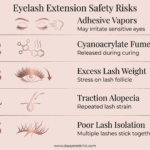
- Application issues → poor isolation, too much weight, wrong placement
- Aftercare mistakes → buildup, twisting, hygiene issues
- Body reaction → irritation or allergy to adhesive fumes
If it’s painless and improving → usually normal
If it’s painful, worsening, or affecting your eyes → not normal
Timing matters more than most people realize:
- Immediate symptoms (same day / first 24h) → usually irritation from fumes or placement
- Delayed symptoms (48–72 hours later) → more likely an allergic reaction
That timing difference is one of the biggest diagnostic clues.
⚠️ Sharp pain, vision changes, strong redness, or swelling are NOT part of a normal lash experience.
These are escalation signals, not “wait and see” situations.
The goal here is simple: Help you quickly figure out what’s normal, what’s not, and what you should do next — without overthinking it.
👀 Before We Dive In
Most lash extension problems come from four things: lash cycle, application, aftercare, or body reaction.
If you’re new to lash extensions, understanding the basics will make everything here much easier to follow.
✨ Inside This Lash Guide
The Most Common Eyelash Extension Problems, Explained One by One
Extensions Falling Out Too Fast
If extensions fall without your natural lash attached, it’s not normal.
Okay, so this is where most people get confused.
If your extensions are falling out, the key question is how they’re falling:
- Falls out with your natural lash → normal shedding
- Falls out on its own (no lash attached) → bonding or application issue
That’s the difference between expected… and something going wrong.
A little shedding is normal. But noticeable loss in the first 24–48 hours usually means the bond didn’t hold properly.
- Light, gradual shedding → normal
- Sudden or early heavy fallout → not normal
What to do:
- Light shedding → monitor
- Early heavy fallout → check with your lash tech
If you’re not sure what a normal lash cycle looks like or how long extensions are supposed to last, this will give you a clear baseline.
If your lashes are falling out very early and you’re unsure whether it’s normal or not, this breaks it down clearly.
- 📌 Is it normal for eyelash extensions to fall out after 2 days
Itching, Irritation, or Burning Sensation
Timing tells you the cause —
- early = irritation,
- delayed = possible allergy.
This is one of the most important distinctions.
- 0–24 hours → usually mild irritation (fumes, sensitivity, placement)
- 48–72 hours + worsening → more likely an allergic-type reaction
Here’s the key difference:
- Irritation → surface-level, often improves
- Allergy → immune response, usually worsens over time
Mild irritation early on can settle.
But if it’s getting worse instead of better — that’s not normal.
🌐 The American Academy of Ophthalmology — highlights risks of irritation and surface damage from lash extensions
🧪 Dr. Sazia (Medical Doctor & Beauty Enthusiast):
“Immediate irritation is often surface-level. But delayed swelling and intense itching suggest an immune response — that’s when you stop and reassess.”
Improving → monitor
Worsening or spreading → stop and reassess
What to do:
- Early, mild irritation → monitor
- Delayed or worsening symptoms → stop and reassess
Red Eyes After Getting Extensions
If redness is painful, spreading, or affecting vision, it’s not normal.
Redness alone isn’t always serious.
What matters is direction — improving or worsening.
- Fades within a day → usually temporary irritation
- Gets worse, deeper, or painful → escalation signal
Watch for:
- sharp pain
- light sensitivity
- discharge
- blurry vision
At that point, it’s no longer simple irritation.
Improving redness → monitor
Painful or worsening redness → escalate
What to do:
- Mild, improving redness → monitor
- Pain, vision changes, or worsening → stop and escalate
If your redness isn’t improving or you want to know exactly what steps are safe to take, this guide walks you through it clearly.
- 📌 For next steps: how to treat red eyes after eyelash extensions
If your symptoms feel more intense or you’re unsure whether it’s something serious, this will help you decide when to escalate.
- 📌 If symptoms feel serious: when to see a doctor for eyelash pain
Clumping or “Stickies”
If lashes feel tight, pinchy, or stuck — it’s not normal.
This is a classic application issue.
“Stickies” happen when multiple natural lashes are glued together instead of being isolated individually.
Here’s why that becomes a problem: Each lash grows on its own timeline.
When they’re stuck together, one grows while another sheds — creating constant tension at the root.
What it feels like:
- pinching when you blink
- tight or pulling sensation
- lashes that don’t move freely
This is not something to wait out.
What to do:
- Don’t pull them apart yourself
- Get them professionally separated or fixed
If you’re not sure how to spot a poor application or what this looks like in real life, this will help you identify it clearly.
- 📌 See what to look for visually: Signs of bad eyelash extensions
Natural Lash Damage or Thinning
Most “damage” is temporary stress — not permanent loss.
This is the one that causes the most panic.
But in most cases, lashes aren’t permanently damaged — they’re just under stress.
It can look like:
- breakage
- premature shedding
- thinner-looking lashes
- slower-looking regrowth
What’s usually happening:
- extensions are too heavy
- Poor isolation adds tension
- Repeated pulling or friction
- rough removal disrupts the cycle
So this is typically mechanical stress, not true follicle damage.
🧪 Engineer Nusrat (An Engineer & A Beauty Enthusiast):
“When extensions are too heavy for the natural lash, it creates continuous downward stress. Over time, that weakens the attachment point and leads to early shedding or a thinning appearance.”
Here’s the key:
- Temporary stress → lashes grow back normally
- Repeated overload → slower regrowth or reduced density
If the follicle isn’t damaged, recovery follows the normal growth cycle.
What to do:
- avoid pulling or picking
- reduce weight/stress
- Give lashes time to recover
Lash Extensions: Twisting or Losing Shape
If it looks messy but feels fine, it’s usually cosmetic, not a health issue.
When lashes start pointing in random directions, it’s usually about placement or balance, not damage.
You might notice:
- lashes turning sideways or crossing
- uneven direction between eyes
- messy or tangled appearance
Common causes:
- natural lash direction
- placement angle issues
- friction (sleeping, rubbing)
- extensions too long or heavy
If it’s just visual, it’s not dangerous
If it becomes uncomfortable or worsens, it needs fixing
What to do:
- Light twisting → monitor
- Messy or uncomfortable → adjust professionally
Extensions Feeling Heavy or Uncomfortable
If extensions feel heavy, pulling, or are constantly noticeable — it’s not normal.
Extensions aren’t supposed to feel obvious.
You shouldn’t be thinking about them all day.
If you are — that’s already a signal something’s off.
What it can feel like:
- constant awareness of your lashes
- pulling or dragging sensation
- discomfort when blinking
- that “these feel like too much” feeling
This usually comes down to a mismatch.
Your natural lashes have a limit.
If extensions go beyond that — in length, thickness, or placement — they create continuous downward stress.
And your lash isn’t built to carry that all day.
Weightless = normal
Heavy or distracting = not normal
What to do:
- slight awareness → monitor
- Ongoing discomfort → get them checked
Gaps Appearing Too Quickly
Gradual gaps are normal — sudden patchiness (especially early) is not.
Gaps can look scary.
But what matters is how fast they appear.
Here’s how to read it:
- Gradual gaps over time → normal shedding
- Sudden patchiness (early days) → retention or application issue
What’s completely normal:
- One eye looks fuller than the other
- uneven shedding
- small gaps building slowly
That’s just how lash cycles work — they’re not synchronized.
What’s not normal:
- large gaps appearing quickly
- patchiness in the first few days
- sudden uneven fallout
Slow changes → expected
Fast, noticeable gaps → something didn’t hold properly
What to do:
- small, gradual gaps → monitor
- fast patchiness → check with your lash tech
Is This Normal or a Red Flag?
If it’s getting worse, painful, or affecting your eyes, it’s not normal.
If you’re ever unsure, come back to this: Is it improving… or getting worse?
That one question answers almost everything.
Usually okay to monitor:
- light itching that settles within a day
- mild redness that improves
- a few extensions shedding daily
- small gaps appearing gradually
- slight twisting or unevenness
- lashes feeling different but not painful
Stop and take it seriously:
- Sharp pain or pinching when blinking
- redness that spreads or worsens
- burning that doesn’t calm down
- swelling around the eyelids
- discharge or crusting
- bloodshot eyes or light sensitivity
- blurry or unusual vision
⚠️ Pain + vision changes = escalation signal (not “wait and see”)
Improving → monitor
Worsening, painful, or eye-related → stop and act
🌐 According to the American Academy of Ophthalmology, it highlights the risk of irritation, corneal damage, and infection from lash extensions
What to do:
- Don’t wait if symptoms are getting worse
- Don’t push through discomfort
What Causes Most Eyelash Extension Problems?
Most problems come from four root causes — not random issues.
By now, there’s a pattern: Problems don’t just happen.
They usually come from a mismatch between application, aftercare, and your body.
- Technician skill issues: Poor isolation, wrong weight, or uneven placement → pinching, heaviness, stress
- Adhesive or placement issues: Glue too close, too much product, weak bonding → irritation, discomfort, poor retention
- Aftercare habits: Rubbing, friction, poor cleansing → gradual changes and instability
- Body sensitivity or reaction: Even with perfect work → itching, redness, swelling
Here’s what helps you read your situation:
- Technical issues → show up early
- Body reactions → show up later or worsen over time
And one important reality: “Safe” doesn’t always mean risk-free.
🌐 According to the U.S. Food and Drug Administration (FDA), cosmetic products are not pre-approved before sale — manufacturers are responsible for their safety and labeling.
What You Can Try First — and What You Shouldn’t Do
If something feels off, doing less is usually safer than doing more.
The instinct is to fix it immediately.
But with lash extensions, overreacting often makes things worse.
What you can try first (low-risk steps):
- Stop rubbing or touching your eyes
- avoid picking at extensions
- Keep the lash area clean if irritated
- reduce friction (sleeping, rubbing)
- Give mild symptoms a short window to settle
These reduce stress and limit further irritation.
What you should avoid:
- Don’t pull or “test” lashes
- Don’t try separating stickies yourself
- Don’t apply random products near the lash line
- Don’t force removal at home
If your instinct is “I just want these off,” that’s a signal that something isn’t right.
Just make sure removal is done properly.
When to Contact Your Lash Tech vs When to Stop and Get Help
If it’s uncomfortable → fixable
If it’s painful, worsening, or affecting your eyes → escalate
Body sensitivity or reaction: Even with perfect work → itching, redness, swelling, and waiting too long.
The key isn’t just what’s happening — it’s how it feels and how it’s progressing.
Contact your lash tech (usually fixable):
- twisting or misdirected lashes
- uneven sets
- abnormal fallout without pain
- heaviness or mild discomfort
- clumping without sharp pain
These are typically application-related issues, not health risks.
Stop and get help (don’t wait):
- swelling around the eyes
- worsening or sharp pain
- discharge or crusting
- severe or spreading redness
- burning that doesn’t settle
- blurry or unusual vision
⚠️ Pain + worsening symptoms or vision changes = escalation signal
These go beyond normal adjustment and should not be ignored.
Simple decision rule:
- Uncomfortable → contact your lash tech
- Painful, worsening, or eye-related → stop and escalate
How to Prevent Eyelash Extension Problems Next Time
Prevention comes down to three things: weight, placement, and care.
Once you understand what causes problems, prevention becomes much easier.
Before your appointment:
- Ask about a patch test if you’ve had sensitivity
- Choose a style that matches your natural lash strength
- avoid going too heavy just for volume
During application: There should be no sharp pain or constant stinging.
- Lashes shouldn’t feel glued to the skin
- Your eyes should feel relaxed, not strained
If something feels off during application, it usually is.
Aftercare basics that actually matter:
- avoid rubbing or pulling
- keep lashes clean (don’t avoid water completely)
- reduce friction while sleeping
- Avoid overloading lashes with products
The biggest shift: Focus on lash health first, not just how they look.
Who May Want to Skip Lash Extensions or Be Extra Careful
If your eyes are already sensitive, your risk is higher, not equal.
Lash extensions can work beautifully — but not for everyone.
If your eyes are already reactive, extensions can amplify sensitivity, not work around it.
Be extra cautious if:
- Your eyes are naturally sensitive
- You’ve had repeated irritation or reactions
- You currently have redness or ongoing irritation
- You rub your eyes frequently
- You’ve had discomfort from extensions before
This doesn’t mean you can’t get extensions.
It means your eyes may react faster — so you need to be more careful.
FAQs About Eyelash Extension Problems
❓ Is it normal for lash extensions to itch the first night?
Mild early itching can be normal — worsening itching is not.
A little itching the first night can happen (fumes or sensitivity).
• settles quickly → usually fine
• worsens after 1–2 days (especially with swelling) → not normal
❓ Why do my lash extensions hurt when I blink?
Pain when blinking is not normal — it’s usually a placement issue.
Common causes:
• lashes stuck together (“stickies”)
• extensions placed too close to the lid
This should be checked, not ignored.
❓ Why are my extensions falling out so fast?
With your lash = normal
Sliding off alone early = not normal
• falls with natural lash → normal cycle
• falls off alone early → bonding or prep issue
❓ Can bad extensions damage natural lashes?
Yes — but usually through ongoing stress, not instant damage.
Heavy extensions, poor isolation, or repeated pulling create continuous tension, which can lead to thinning or early shedding over time.
❓ Should I remove them right away?
Mild issues → adjust
Pain, swelling, or worsening → remove
• unevenness or light fallout → can be fixed
• pain, swelling, worsening irritation → safer to remove
Final Thoughts
Most eyelash extension problems fall into two paths: normal vs warning signs.
By now, the pattern is clear:
- small issues → can be adjusted or monitored
- warning signs → should not be ignored
Usually normal:
- light shedding
- minor gaps
- slight unevenness
Not normal:
- pain
- worsening redness
- swelling
- vision changes
⚠️ Those are not “wait and see” situations.
Simple rule to follow:
- improving → give it time
- worsening → act early
At the end of the day, lash extensions should feel easy and comfortable — not something you’re constantly worried about.
If something feels off, trust that early. It usually saves you from bigger problems later.