⚡Quick Answer
Eyelash extension sizes are based on three core measurements: length, diameter, and curl.
Length controls how long the lashes appear, diameter controls how soft or bold they look, and curl determines how lifted the lashes appear on the eye. Lash artists combine these three sizing factors to create natural, wispy, or dramatic results while keeping the extensions appropriate for your natural lash strength.
If you’ve ever looked at a lash menu and seen numbers like 10mm, 12mm, or 0.07 diameter, it can feel a little confusing at first.
That’s because eyelash extension size does not mean just one thing.
In professional lash design, size always refers to three measurements working together: length, diameter, and curl.
This eyelash extension size guide explains how those three measurements work together so you can understand lash charts, follow salon recommendations more easily, and recognize why some sets look soft and natural while others look more dramatic.
Many beginners assume lash sizing is simply about choosing longer lashes. In reality, lash artists treat sizing more like a balance system. They look at how long the extensions are, how thick they are, how lifted they appear, and whether your natural lashes can comfortably support that combination.
So before we get into the details, the most important thing to know is this: Lash size is always a three-part system, not a single number.
👀 Before We Dive In
Before we break down lash sizes, it helps to understand what eyelash extensions are and why lash artists measure them so carefully.
✨ Inside This Lash Guide
Why Lash Extension “Size” Confuses So Many People
A lot of people hear something like 12mm lashes and assume that’s the entire sizing decision.
So it’s easy to think lash size only refers to length. But professional lash sizing works differently.
In practice, lash artists evaluate three separate sizing factors, and each one changes the final result in a different way. One affects visible length, one affects how light or dense the set appears, and one controls how lifted the lashes look once they’re applied.
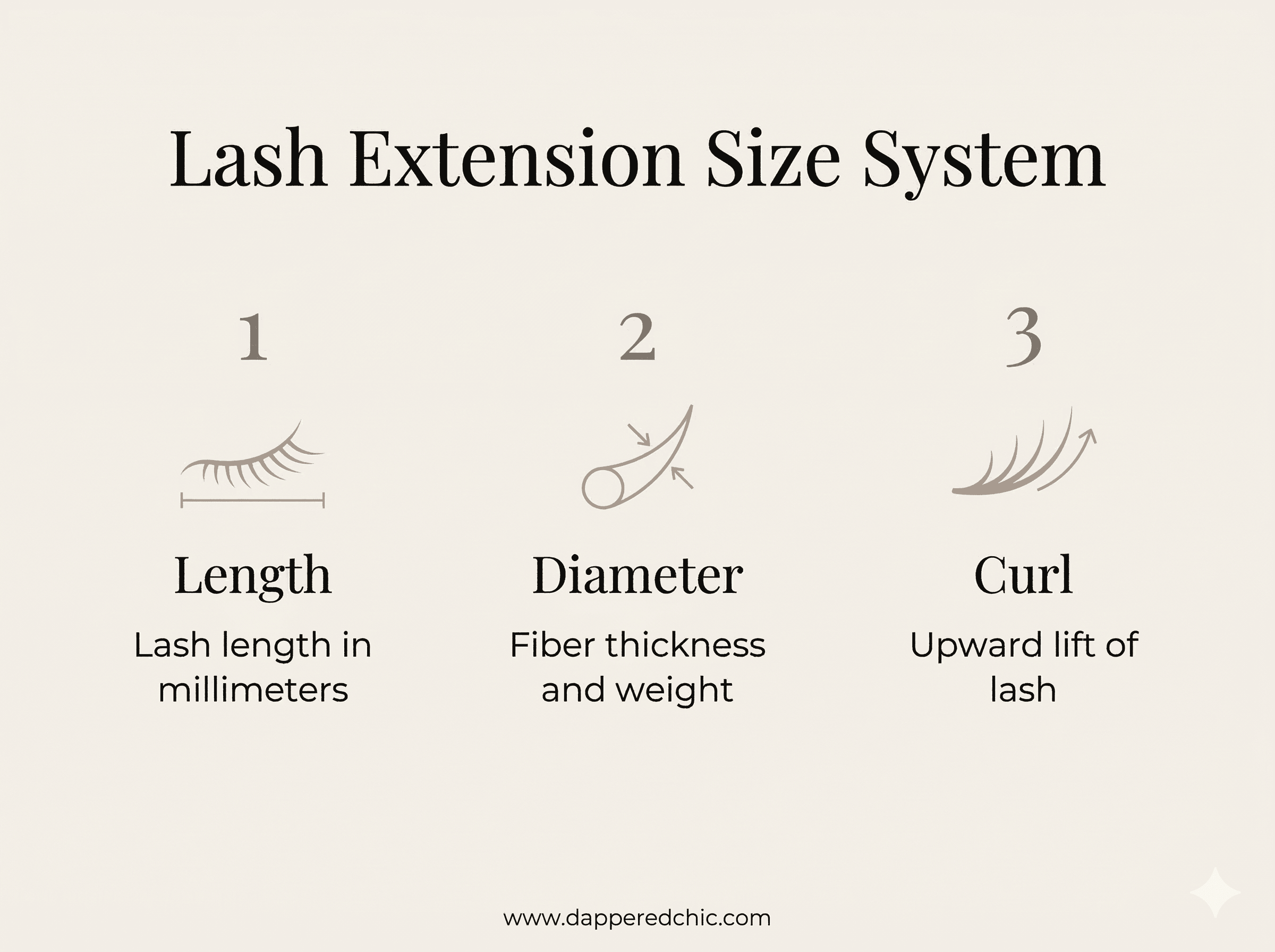
Those three sizing factors are:
- Length — how long the extension is in millimeters
- Diameter (thickness) — how thick or fine the lash fiber is
- Curl — how much the extension lifts upward
Together, those three measurements shape the overall look.
A softer, more natural set might use shorter lengths, finer diameters, and a gentle curl.
A more dramatic set might use longer lengths, denser fibers, or a stronger curl.
But even then, appearance is only part of the decision.
Lash artists also have to consider whether your natural lashes can safely support that combination of size and weight. In other words, good sizing is not only about style — it’s also about keeping the set appropriate for your natural lash condition.
That’s why understanding these three sizing elements is so important. Once you understand them, the rest of the eyelash extension size guide becomes much easier to follow.
The Three Things That Actually Determine Lash Extension Size
When lash technicians talk about extension size, they are not referring to a single number.
Every eyelash extension is defined by three measurements working together:
- Length
- Diameter (thickness)
- Curl
These three elements act as the core dimensions of lash design. Changing even one of them can noticeably affect how the lashes look and how much weight they place on the natural lash.
Because of this, lash sizing is always determined by a combination of measurements, not by length alone.
Let’s look at each one.
Lash Length (Measured in Millimeters)
Length is the measurement most people recognize first.
Lash extensions are measured in millimeters (mm), and most everyday lash sets usually fall between 8mm and 15mm.
Shorter lengths tend to create a softer, more natural result, while longer extensions make the lashes appear more noticeable and dramatic.
However, longer extensions are not always the best choice. Lash artists typically match extension length to the length and strength of your natural lashes, because longer fibers create more leverage at the lash root.
Here is a simplified example of how common lash lengths typically appear:
| Length | Result |
|---|---|
| 8–10mm | Natural, subtle enhancement |
| 11–12mm | Everyday glam |
| 13–15mm | Dramatic lash look |
Most professional lash sets blend several lengths together rather than using one size across the entire eye. Mixing lengths helps the lashes look more balanced and natural.
Lash Diameter (Thickness)
Diameter refers to how thick each individual extension fiber is.
This measurement strongly affects both the visual density and the weight of the lash set. Even if two extensions have the same length, a thicker diameter will look darker and feel heavier.
Common lash diameters include:
| Diameter | Typical Use |
|---|---|
| 0.03–0.05 | Mega volume sets |
| 0.07 | Volume lashes |
| 0.10–0.15 | Classic extensions |
Many beginners assume length determines lash weight, but diameter usually has a greater influence on mass.
Even a small increase in thickness can noticeably increase the weight of the extension fiber. Because of this, volume lash techniques rely on very fine fibers, allowing multiple lashes to be used without placing excessive load on the natural lash.
Lash Curl Types
Curl is the third dimension of lash sizing. It determines how lifted the lashes appear once they are applied.
Different curl profiles produce different visual effects, ranging from subtle enhancement to a more lifted appearance.
Common lash curls include:
| Curl | Look |
|---|---|
| J | Very subtle curl |
| B | Soft natural curve |
| C | Noticeable natural lift |
| D | Dramatic curl |
| L | Strong lifting effect |
Curl does not significantly change lash weight, but it can greatly influence how open or lifted the eyes appear.
Because of this, lash artists often adjust curl types depending on the natural direction of a client’s lashes.
Lash Extension Length Chart (What Each Size Looks Like)
Lash extensions are measured in millimeters, and even small differences in length can noticeably affect the final result.
A change of just 1–2mm can shift a lash set from natural-looking to noticeably glam.
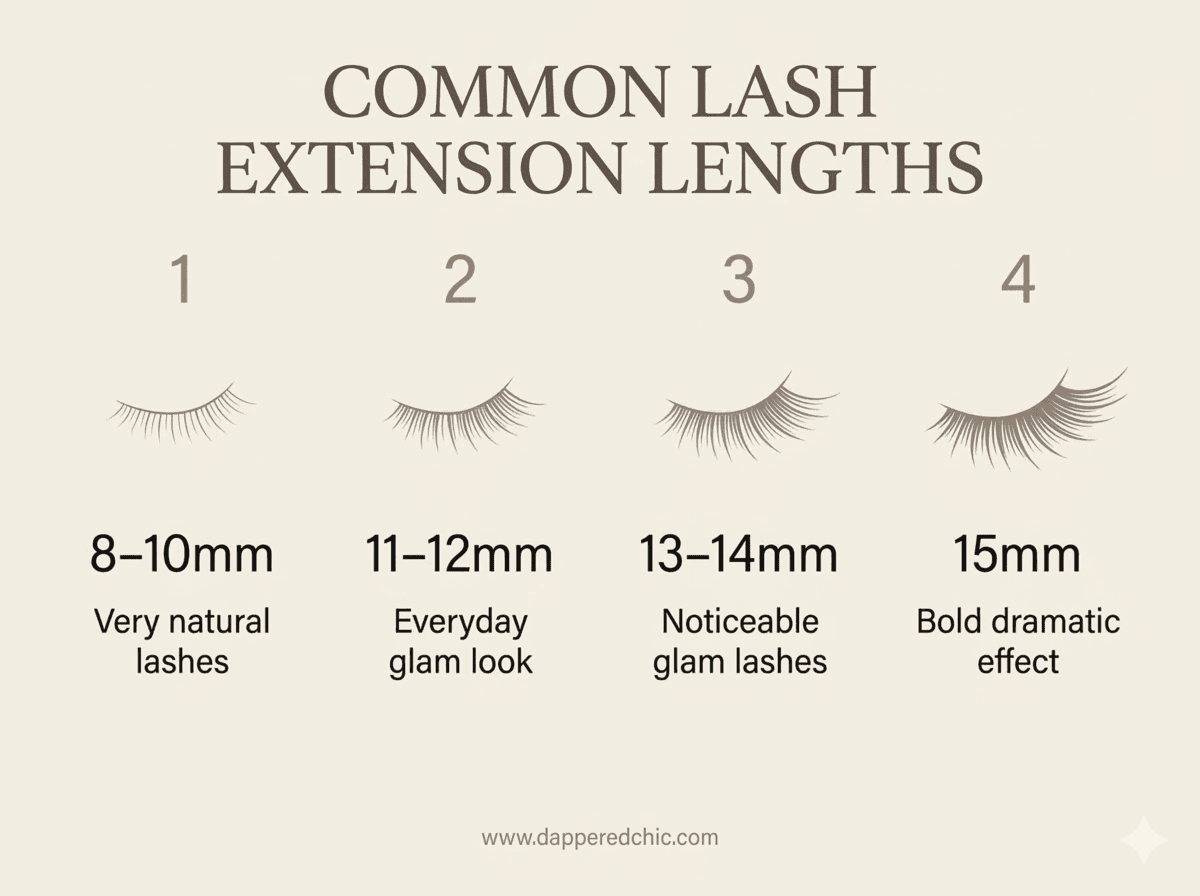
Here’s a simple reference chart showing how common lengths typically appear:
| Length | Typical Look |
|---|---|
| 8mm | Very natural |
| 9–10mm | Subtle enhancement |
| 11–12mm | Noticeable everyday lashes |
| 13–14mm | Glamorous look |
| 15mm | Dramatic lash effect |
Shorter lengths tend to blend closely with natural lashes, while longer extensions create a stronger visual impact.
In practice, salons rarely apply one length across the entire eye. Lash artists usually mix several lengths to keep the result balanced and comfortable.
How Lash Techs Choose the Right Size for Your Natural Lashes
Choosing lash extension sizes is not only about appearance. Lash technicians also evaluate the condition of the natural lashes before deciding which sizes will work safely.
During a consultation, artists often consider several factors:
- Natural lash strength — stronger lashes can support slightly longer or thicker extensions
- Lash growth cycle — lashes in different growth phases support different weights
- Natural lash direction — upward or downward growth influences curl choice
- Client comfort — very long or heavy extensions can feel uncomfortable during blinking
Because of these factors, many salons follow a widely used guideline often called the 2mm rule.
This guideline suggests that extensions should usually remain only a few millimeters longer than the natural lash. Going far beyond that range can increase strain on the lash follicle and may lead to premature shedding.
🧪 Engineer Nusrat (An Engineer & Beauty Enthusiast):
Longer lash extensions behave somewhat like a small lever attached to the natural lash. As extension length increases, the mechanical load at the lash root increases as well. Thicker extensions add additional mass, increasing that load further.
Because of this, lash technicians balance length, diameter, and curl together so the extensions create the desired look while remaining appropriate for the natural lashes.
Natural Lash Look vs Dramatic Lash Look
One of the biggest differences between lash extension sets is how subtle or bold the final result appears.
Some people prefer lashes that look almost like their natural lashes — just a little darker and fuller. Others prefer a more noticeable set that makes the eyes stand out more clearly.
That difference usually comes from how length, diameter, and curl are combined in the lash set.
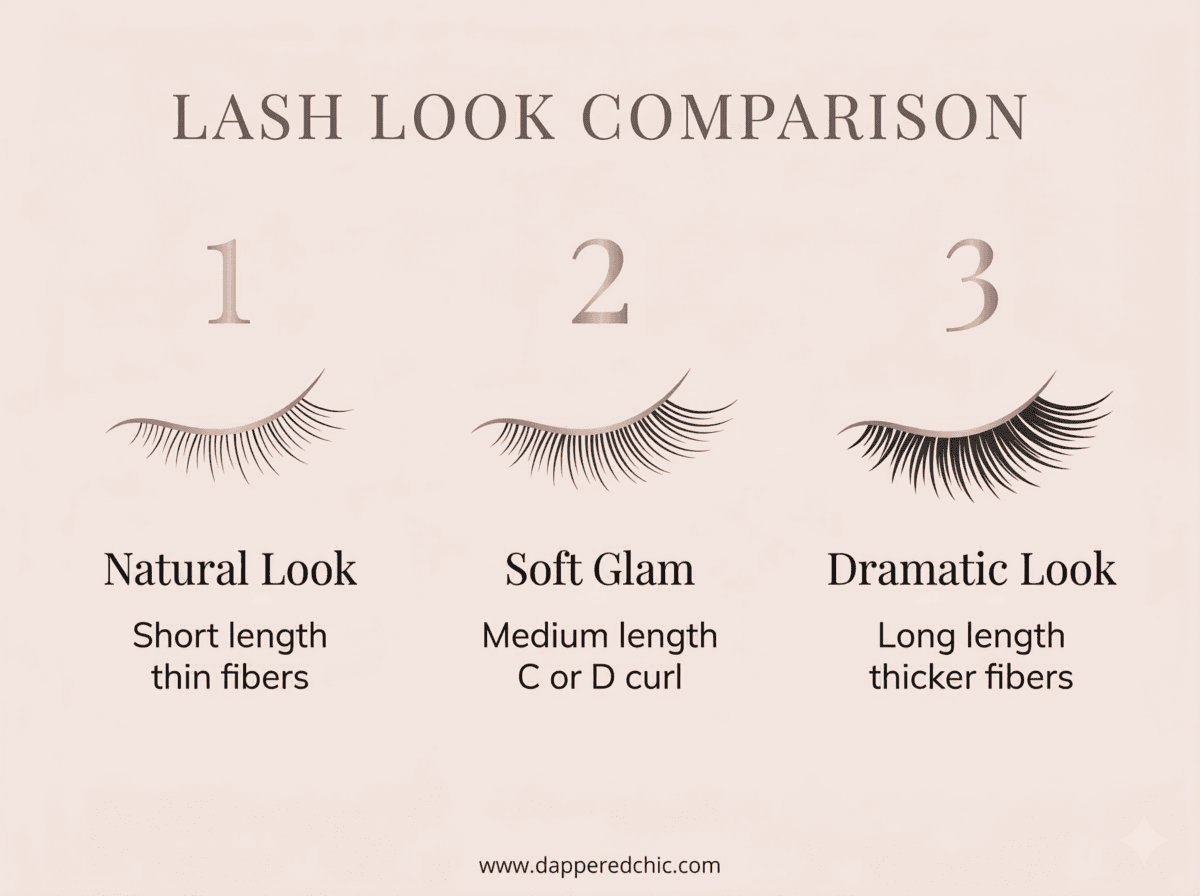
Here’s a simplified way to visualize how those combinations influence the final look:
| Look | Length | Thickness | Curl |
|---|---|---|---|
| Natural | 8–11mm | Thinner | C |
| Soft glam | 10–13mm | Medium | C / D |
| Dramatic | 12–15mm | Thicker | D |
- A natural set usually stays close to the client’s natural lash length and often uses thinner diameters so the lashes remain lightweight.
- A soft glam set typically adds slightly more length and lift while still looking wearable for everyday settings.
- A dramatic set often uses longer lengths or stronger curls to create a bold, eye-opening effect that is easier to notice from a distance.
The important point is that lash size is never determined by one measurement alone. The final appearance always depends on how length, diameter, and curl work together.
The Most Common Lash Mapping Sizes Used in Salons
Professional lash sets rarely use the same extension length across the entire eye.
Instead, lash artists divide the lash line into zones and gradually adjust the extension lengths across those zones. This helps the set follow the natural shape of the eye while keeping the result balanced.
A very common beginner-friendly mapping pattern looks like this:
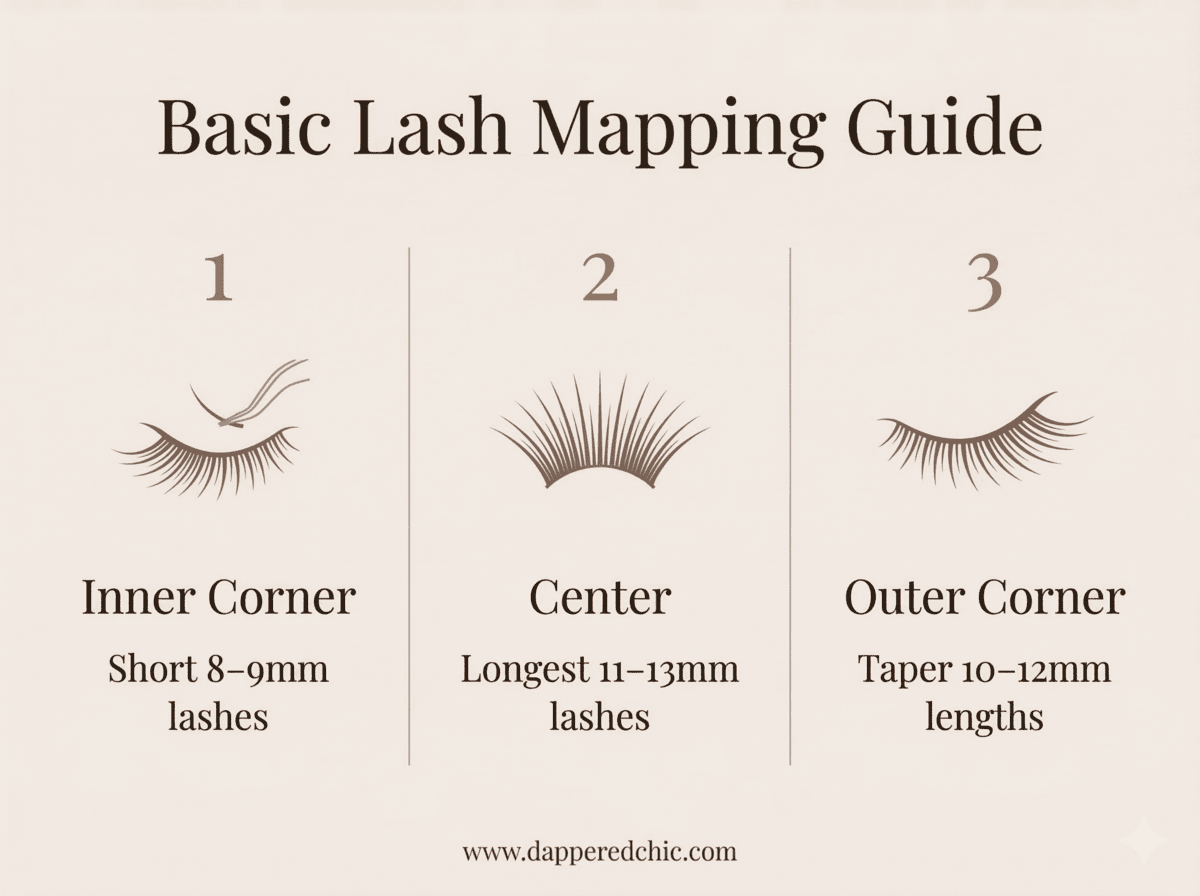
| Lash Zone | Length |
|---|---|
| Inner corner | 8–9mm |
| Center | 11–13mm |
| Outer corner | 10–12mm |
Shorter extensions are usually placed near the inner corner, where natural lashes are often more delicate.
The center of the eye commonly holds the longest lengths because lashes there are typically stronger and can support slightly longer extensions.
Toward the outer corner, technicians usually taper the length slightly so the lash line stays lifted rather than drooping downward.
Different lash styles mainly change where the longest lengths are placed, while still following the same basic sizing principles. For example:
- Doll eye: longest lashes placed toward the center
- Cat eye: lengths gradually increase toward the outer corner
- Natural eye: lengths follow the natural lash growth pattern
These style variations mainly adjust placement patterns, while the core sizing rules remain the same.
- 📌 Eyelash extension style chart
Can You Choose Lash Size Yourself or Should You Trust the Lash Artist?
It’s completely normal to have preferences about how you want your lashes to look.
Many clients arrive at their appointment already knowing whether they want a natural, soft glam, or dramatic result.
However, choosing the exact lash sizes is usually something best handled by the lash technician.
What clients should communicate clearly is:
- whether they want a natural or glam look
- how comfortable they want the lashes to feel
- their lifestyle habits (for example, workouts, swimming, or frequent eye rubbing)
These details help the lash artist understand the overall goal for the set.
From there, technicians adjust the technical sizing based on factors clients typically cannot evaluate themselves, such as:
- natural lash strength
- eye shape and lash direction
- long-term lash health
Because every person’s natural lashes are different, the safest and most flattering size combination usually comes from a collaboration between client preference and technician expertise.
Mistakes People Make When Choosing Lash Extension Size
One of the most common problems with lash extensions happens when the size is chosen only based on appearance.
Beginners sometimes assume that longer or thicker lashes will automatically look better. In reality, oversized extensions can feel uncomfortable and may not suit the natural lash line.
Some common mistakes include:
- requesting extremely long lashes that exceed natural lash length too much
- choosing thick diameters instead of lightweight volume fans
- ignoring eye shape, which can make the lash set look unbalanced
Another important thing to remember is that natural lash shedding still occurs, even with properly applied extensions.
Natural lashes follow a growth cycle. When a lash reaches the end of that cycle, the extension attached to it will fall out with it. This is normal and does not necessarily indicate a problem with the lash set.
Will Bigger Lash Extensions Damage Your Natural Lashes?
Eyelash extensions themselves do not automatically damage natural lashes. Most problems occur when the size of the extensions does not match the strength of the natural lash.
Issues are more likely to occur when:
- extensions are too long for the natural lash
- extensions are too thick or heavy
- Poor application causes multiple lashes to be glued together
When an extension is oversized, it can place extra strain on the base of the natural lash where the follicle anchors the hair.
This strain is often described as follicle stress. Over time, excessive weight or leverage may contribute to premature shedding or weakened lashes.
That is why professional lash artists carefully adjust extension sizes instead of simply choosing the longest lashes available.
Safe sizing generally means the extension length and thickness remain within the limits that the natural lash can comfortably support.
Oversized extensions, on the other hand, increase mechanical stress on the lash root.
🌐 According to the American Academy of Ophthalmology, Excessive tension on hair follicles can contribute to traction-related hair loss when constant pulling stress is applied.
🧪 Dr. Rabeya (Dental Surgeon & Beauty Enthusiast):
The eyelash follicle is a delicate structure anchored within the eyelid skin. When extensions are too long or too heavy, they can create traction stress at the follicle base. Over time, repeated tension may weaken the lash or contribute to premature shedding.
This is why trained lash professionals carefully adjust extension lengths and thickness so the final set looks full while still protecting the health of the natural lashes.
Lash Extension Size for Different Eye Shapes
Although lash extension sizing mainly focuses on length, diameter, and curl, technicians may also make small adjustments based on eye shape when deciding the final combination.
These adjustments usually involve curl selection or where longer lengths are placed, rather than changing the core sizing rules.
Hooded Eyes
Hooded eyes often benefit from stronger curls, such as D or L curls.
These curls help lift the lashes upward so they remain more visible even when the eyelid partially covers the lash line.
Almond Eyes
Almond eyes are one of the most flexible eye shapes for lash extensions.
Most curl types can work well, allowing lash artists to adjust the final look depending on whether the client prefers a natural or more dramatic appearance.
Round Eyes
Round eyes can appear even wider if the longest lashes are placed in the center of the eye.
To create a slightly more elongated effect, technicians often position longer lengths toward the outer portion of the lash line instead.
Downturned Eyes
Downturned eyes often benefit from lifting the outer corner using stronger curls such as D or L curls.
This helps counterbalance the downward angle and can create a more lifted overall appearance.
If you want to see how different eye shapes influence lash styling choices beyond sizing alone, this guide explains the full mapping approach.
- 📌 Eye shapes for eyelash extensions
Quick Lash Extension Size Cheat Sheet
If you want a quick reference before your lash appointment, this chart shows how common lash size combinations typically translate into different looks.
| Goal | Length | Diameter | Curl |
|---|---|---|---|
| Natural | 8–11mm | Thin | C |
| Soft glam | 10–13mm | Medium | C / D |
| Dramatic | 12–15mm | Thicker | D |
- A natural set usually stays close to the length of your natural lashes and often uses thinner diameters so the extensions feel lightweight.
- A soft glam set adds slightly more length and density while still looking wearable for everyday situations.
- A dramatic set typically uses longer lengths or thicker fibers to create a more noticeable, high-impact lash look.
💡 If you’re planning a lash appointment, saving or screenshotting this chart can make it easier to explain the style you want during your consultation.
Frequently Asked Questions About Lash Extension Sizes
❓ What is the most natural eyelash extension size?
Most natural-looking lash sets use lengths between 8mm and 11mm, thinner diameters, and a C curl.
These sizes stay relatively close to natural lash length, which helps the extensions blend smoothly with your own lashes.
❓ What lash length do most salons use?
Many salons commonly use 10mm–12mm as the center length in a lash set.
This range usually provides noticeable definition without looking overly dramatic, which is why it is popular for everyday lash styles.
❓ Are longer lash extensions heavier?
Longer extensions can place more leverage on the natural lash, which may increase mechanical stress near the lash root.
Even when the diameter remains the same, increasing extension length generally increases the load applied to the natural lash.
❓ What size lash extensions are safest?
Safer lash sizes are typically only slightly longer than the natural lash and use diameters appropriate for the lash’s strength.
Many technicians follow a guideline where extensions remain around 2mm longer than the natural lash to reduce excessive strain.
❓ Can short natural lashes handle long extensions?
Usually not.
If natural lashes are short or delicate, extremely long extensions can place too much weight on the lash root. In those cases, technicians usually choose shorter lengths and lighter diameters so the lashes remain comfortable and healthy.
Final Takeaway
Eyelash extension size isn’t simply about choosing longer lashes.
Every lash set is built using a combination of length, diameter (thickness), and curl. When these three elements are balanced correctly, extensions can create anything from a subtle enhancement to dramatic volume while still staying appropriate for the natural lashes.
The most important thing to remember is that safe sizing comes first. Lash technicians adjust extension length and thickness based on the strength of your natural lashes, so the final result looks flattering without placing unnecessary stress on the lash follicle.
Once you understand how lash sizing works, reading lash charts and discussing your desired look during a salon consultation becomes much easier.
🎁 Before You Go
If you’re exploring lash extensions for the first time, understanding sizes is just the starting point.
The next step is learning how lash styles and eye shapes influence the final result.
You might want to read these next:
- 📌 Eyelash extension style chart
- 📌 Eye shapes for eyelash extensions