
⚡ Quick Answer
Yes. An eyelash glue allergy happens when your immune system reacts to ingredients in lash adhesive, most often cyanoacrylate.
Here’s a quick way to tell the difference:
- Irritation: burning or watery eyes during or right after application from adhesive fumes
- Allergy: itching, swelling, or redness appearing 24–72 hours later that may worsen
- Warning signs: severe swelling, eye pain, or vision changes require medical care
Common early symptoms include itching, redness, swelling, burning, or watery eyes around the lash line.
Eyelash extensions rely on strong adhesives to hold lashes in place for weeks. While most people tolerate them well, some develop sensitivities or allergic reactions to the adhesive.
An eyelash glue allergy usually affects the eyelids and lash line, causing itching, redness, swelling, or irritation.
These reactions can be confusing because they often appear hours or days after a lash appointment, not immediately.
Understanding how eyelash glue reactions develop can help you recognize symptoms early and take the safest next steps to protect your eyes.
👀 Before We Dive In
Not every reaction after lash extensions is an allergy.
Many reactions come from temporary irritation caused by adhesive fumes, while symptoms that appear later or worsen over time may signal a delayed eyelash glue allergy.
In this guide, you’ll learn:
- How to recognize the symptoms
- What causes lash adhesive reactions
- What to do if your eyes react
📌 For a quick comparison, see eyelash extension allergy vs irritation.
📌 If symptoms feel severe, read when to see a doctor for eyelash pain.
✨ Inside This Lash Guide
What Is an Eyelash Glue Allergy?
An eyelash glue allergy happens when your immune system reacts to one or more ingredients in lash adhesive. In medical terms, this reaction is usually classified as allergic contact dermatitis affecting the eyelids or the surrounding eye area.
In simple terms, the body begins treating something in the adhesive as a threat. When that happens, the skin around the lash line may become itchy, swollen, red, or irritated after exposure.
However, an important detail often gets missed: not every reaction to lash glue is an allergy.
Sometimes the eyes react to vapors released while the adhesive cures, especially during or immediately after a lash appointment. These reactions are usually temporary and fall into the category of irritation rather than allergy.
A true eyelash adhesive allergy behaves differently. Instead of settling quickly, symptoms often appear later and linger longer, particularly around the eyelids.
Understanding that difference is the first step in recognizing whether your eyes are reacting to the glue itself or simply to temporary irritation during application.
Eyelash Glue Allergy vs Normal Irritation
People confuse these two reactions all the time.
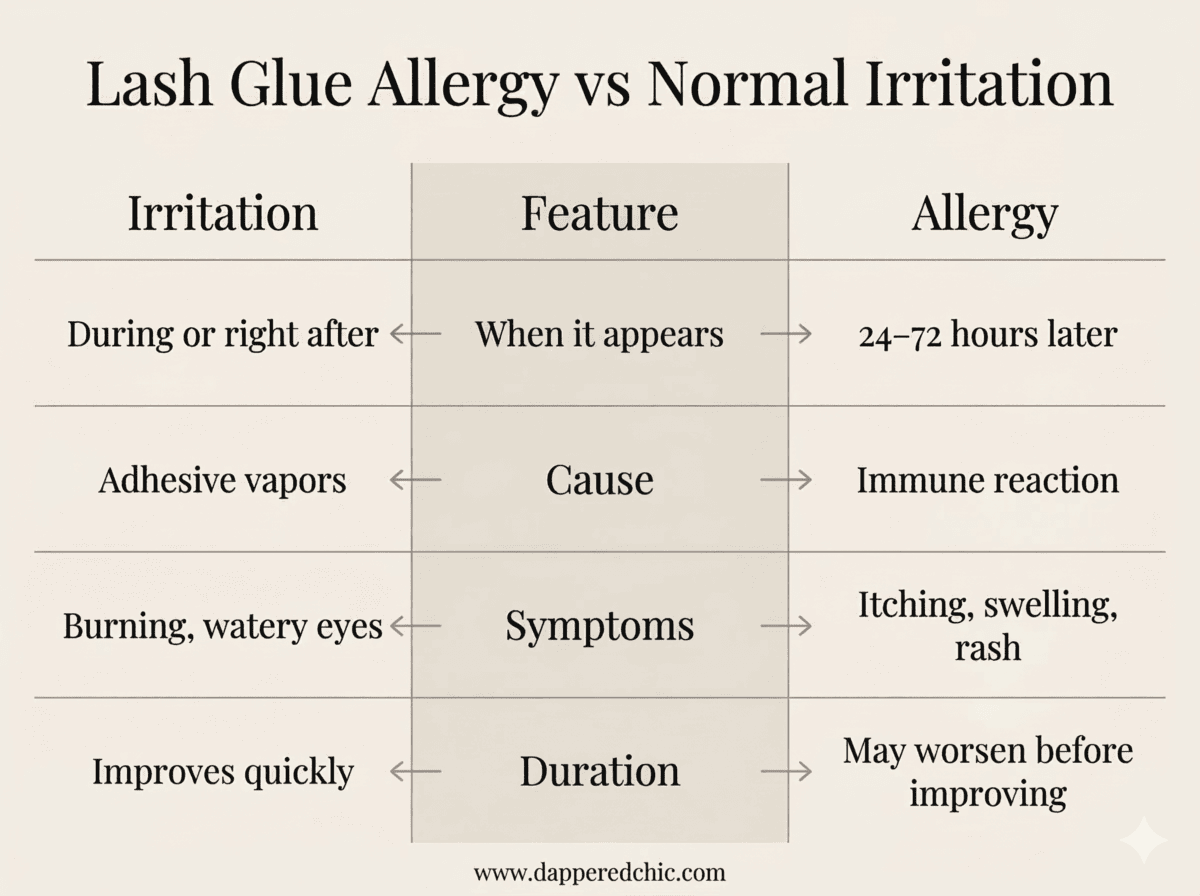
Both can leave the eyes red or uncomfortable after a lash appointment, but the cause, timing, and symptom pattern are usually very different.
Allergy
When the reaction is allergic, the immune system is involved, and the eyelid skin reacts to a substance in the adhesive.
Common patterns include:
- Persistent itching around the eyelids
- Noticeable swelling or puffiness
- Red or rash-like skin near the lash line
- Symptoms that appear hours later or worsen over time
Unlike simple irritation, allergic reactions often do not settle quickly once the appointment ends. They may appear later and gradually worsen before improving.
Irritation
Irritation is much more common and usually happens because of adhesive vapors released while the glue cures.
Typical signs include:
- Stinging or burning sensation
- Watery eyes
- Temporary redness
- Symptoms that start quickly and fade once exposure stops
This occurs because curing lash adhesive releases vapors that can irritate the eye’s surface and nearby tissue. Once those fumes dissipate, symptoms typically improve fairly quickly.
Why They Feel So Similar
Both reactions occur in the same delicate eye area, which means the symptoms can look almost identical at first.
That’s why many people assume they are “allergic” when they are actually experiencing temporary irritation. In most cases, timing and symptom duration are the clearest clues.
🧪 Engr. Nusrat (Engineer & Beauty Enthusiast):
From a technical standpoint, lash adhesive reactions can feel confusing because of how the glue cures. During application, cyanoacrylate adhesives polymerize when they contact moisture, releasing small amounts of vapor. These fumes can irritate the eyes immediately, while allergic reactions tend to appear later after repeated exposure.
📌 If you want a deeper breakdown of symptoms and timelines, see eyelash extension allergy vs irritation.
What Causes Eyelash Glue Allergies?
Most cases of eyelash glue allergy trace back to the adhesive used to attach lash extensions. These adhesives are designed to bond quickly and hold lashes in place for weeks, which means they contain strong chemical bonding agents.
The most common trigger is cyanoacrylate, the fast-curing ingredient that allows lash extensions to attach securely to natural lashes. For many people, this ingredient causes no issues, but in some individuals, the immune system eventually becomes sensitive to it.
Over time, repeated exposure to the same adhesive can cause the immune system to gradually develop sensitivity to that ingredient. When that happens, the body may begin reacting to lash glue that previously caused no problems.
Another factor is adhesive curing strength. Professional lash glues are formulated for strong retention, and faster-drying formulas can release more vapors during the curing process. These fumes can irritate the eyes and may contribute to sensitization over time.
In addition to the bonding ingredient itself, some people may react to supporting ingredients within the adhesive formula, which can increase irritation risk for sensitive users.
Understanding how lash adhesives work can also help explain why reactions sometimes appear suddenly after years of wearing extensions.
📌 For a broader safety overview of lash adhesives and how they affect the eye area, see eyelash glue safety.
Cyanoacrylate and Why It Matters
Cyanoacrylate is the core bonding ingredient used in most professional lash adhesives.
It works by reacting with moisture in the air or on the natural lash, quickly turning from a liquid into a solid polymer bond that holds the extension in place.
This rapid curing process is what allows lash extensions to remain attached for weeks rather than hours.
However, this same chemical reaction can produce vapors during the curing process. When those vapors reach the delicate skin around the eye or the eye’s surface itself, they may trigger irritation.
For people who become sensitized over time, the immune system may begin recognizing the adhesive as an allergen.
This process often develops gradually. Repeated exposure to cyanoacrylate can slowly train the immune system to react more strongly to the ingredient, which is why someone may wear lash extensions for months or even years before experiencing symptoms.
Other Ingredients That Can Make Things Worse
While cyanoacrylate is the primary trigger in most lash adhesive reactions, other ingredients can sometimes contribute to irritation.
Examples include:
- Carbon black, a pigment used in black adhesives, may irritate sensitive skin
- Latex, which sometimes appears in strip-lash adhesives rather than extension glues
- Stabilizers and preservatives are used to prevent the adhesive from curing inside the bottle
These ingredients are not harmful to most people. However, individuals with sensitive skin or existing eye conditions may react more strongly.
It is also important to understand that products labeled “sensitive” or “low-fume” may reduce irritation for some users.
However, most extension adhesives still rely on cyanoacrylate-based bonding agents, which means no cyanoacrylate lash glue can be considered completely allergy-proof once someone has become sensitized.
What Symptoms Do People Usually Notice First?
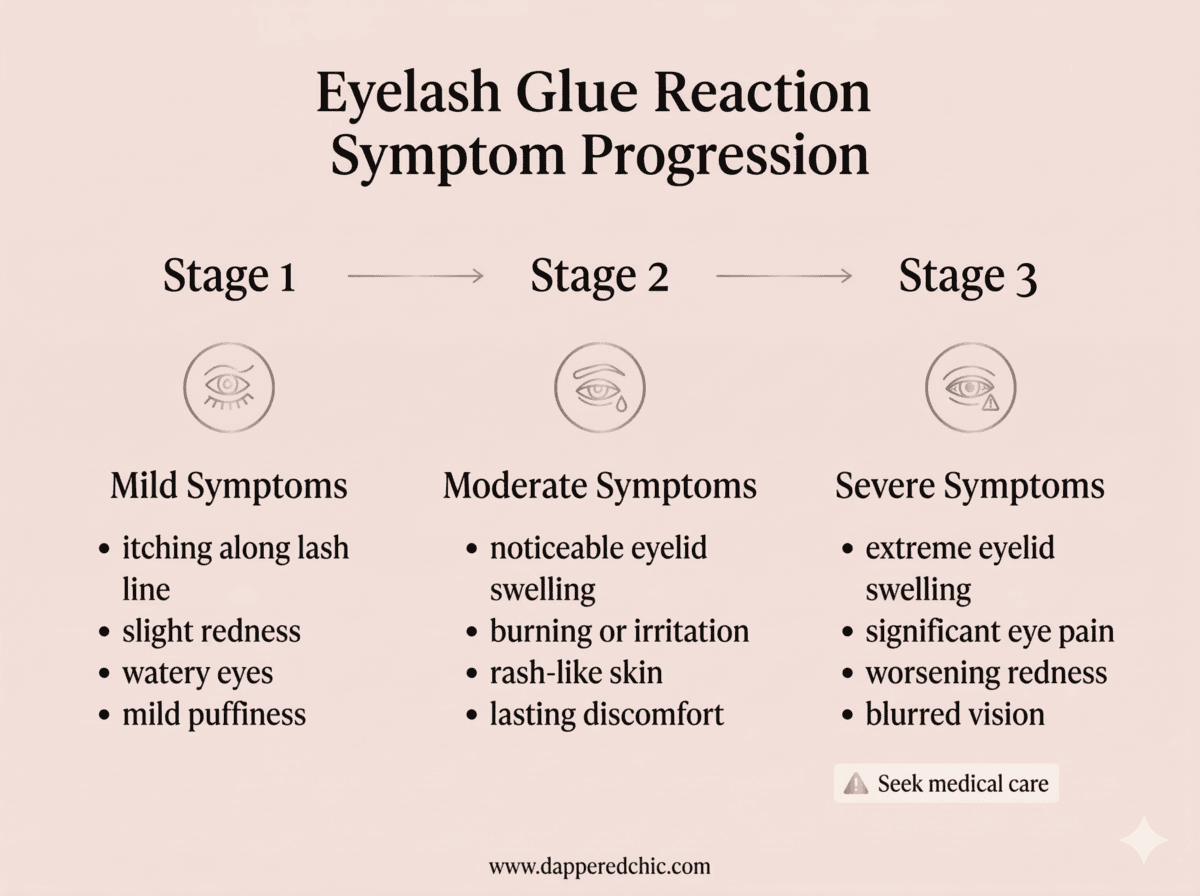
Reactions to eyelash adhesive rarely appear all at once. In many cases, symptoms develop gradually, starting mild and becoming more noticeable if exposure continues or the immune system reacts strongly.
Understanding how symptoms tend to progress can make it easier to recognize when something is a temporary irritation and when it may signal a true eyelash glue allergy.
Early Mild Symptoms
Early signs usually appear around the eyelids or lash line shortly after a lash appointment or within the first day.
People commonly notice:
- Itching along the lash line
- Slight redness around the eyelids
- Watery eyes
- Mild puffiness
- Tenderness or sensitivity near the lashes
These symptoms are often linked to temporary irritation from adhesive fumes or mild sensitivity in the eye area.
Moderate Symptoms
If the reaction progresses, symptoms may become more noticeable and uncomfortable.
At this stage, people often experience:
- Clearly puffy eyelids
- A stronger burning or irritated feeling
- Skin around the eye is becoming rash-like or inflamed
- Discomfort that lasts longer than the first few hours after application
When symptoms persist, worsen, or appear later rather than improving quickly, it raises the likelihood that the reaction may be allergic rather than simple irritation.
Severe Symptoms That Need Medical Attention
Some reactions require prompt medical attention, particularly if the eye itself becomes involved.
⚠️ Warning signs include:
- Extreme swelling around the eyelids
- Blistering or intense skin irritation
- Significant eye pain
- Worsening redness of the eye
- Blurred vision or vision changes
- Difficulty comfortably opening the eye
These symptoms should never be ignored, especially when the eye surface becomes involved.
🧪 Dr. Tropa (Medical Doctor & Beauty Enthusiast):
Severe eyelid swelling, pain, or vision changes should always be evaluated by a healthcare professional. The eye area is delicate, and symptoms that move beyond mild irritation may indicate a more serious inflammatory reaction.
🌐 According to the American Academy of Ophthalmology, symptoms such as eye pain, vision changes, or severe swelling are red-flag signs that require medical evaluation.
📌 If symptoms feel severe or unusual, see when to see a doctor for eyelash pain.
How Long After Applying Lash Glue Can a Reaction Show Up?
One of the most confusing aspects of eyelash glue allergy is timing. Some reactions happen quickly, but many allergic responses do not appear right away.
Irritation from adhesive fumes often shows up during or shortly after the appointment. Eyes may feel watery, sting slightly, or look red for a short time while the glue cures.
In many cases, these symptoms improve once exposure stops and the vapors dissipate. Allergic reactions behave differently.
Instead of appearing immediately, symptoms can develop 24 to 72 hours later. Someone might leave a lash appointment feeling completely fine and only notice itching, swelling, or redness the next day or even two days later.
This delayed pattern is one reason eyelash glue allergies are often misunderstood. Because symptoms appear later, it can be difficult to connect the reaction to the lash appointment.
Another complication is that reactions can build gradually. A mild itch on the first day may turn into noticeable swelling or irritation by the second or third day.
For readers trying to understand what happened, the timeline of symptoms becomes one of the most useful clues.
Reactions that appear hours or days later and continue to worsen are more consistent with an allergic response to eyelash adhesive than simple irritation.
Can You Suddenly Become Allergic to Eyelash Glue?
Yes — and this surprises many people.
Someone can wear lash extensions for months or even years without problems, then suddenly experience a reaction. This usually happens because allergic responses develop through a process called sensitization.
With repeated exposure to lash adhesive, the immune system can slowly become more sensitive to certain ingredients — most commonly cyanoacrylate.
Over time, the body may begin recognizing that chemical as a threat.
Once that threshold is reached, the next exposure can trigger a noticeable reaction.
This is why people sometimes say:
- “I’ve been getting lashes for two years with the same glue.”
- “Nothing changed at the salon.”
- “But suddenly my eyes reacted.”
From the outside, it may seem random, but biologically, it often reflects cumulative exposure over time.
Another factor is that the skin around the eyes is extremely thin and reactive. Small changes in skin barrier health, stress, or environmental conditions can make the area more sensitive to substances it previously tolerated.
For many people, the reaction feels sudden, but the underlying sensitization has usually been developing quietly in the background.
📌 If you want a deeper explanation of this process, see why I am suddenly allergic to eyelash glue.
What to Do Right Away If You Think Lash Glue Caused the Reaction
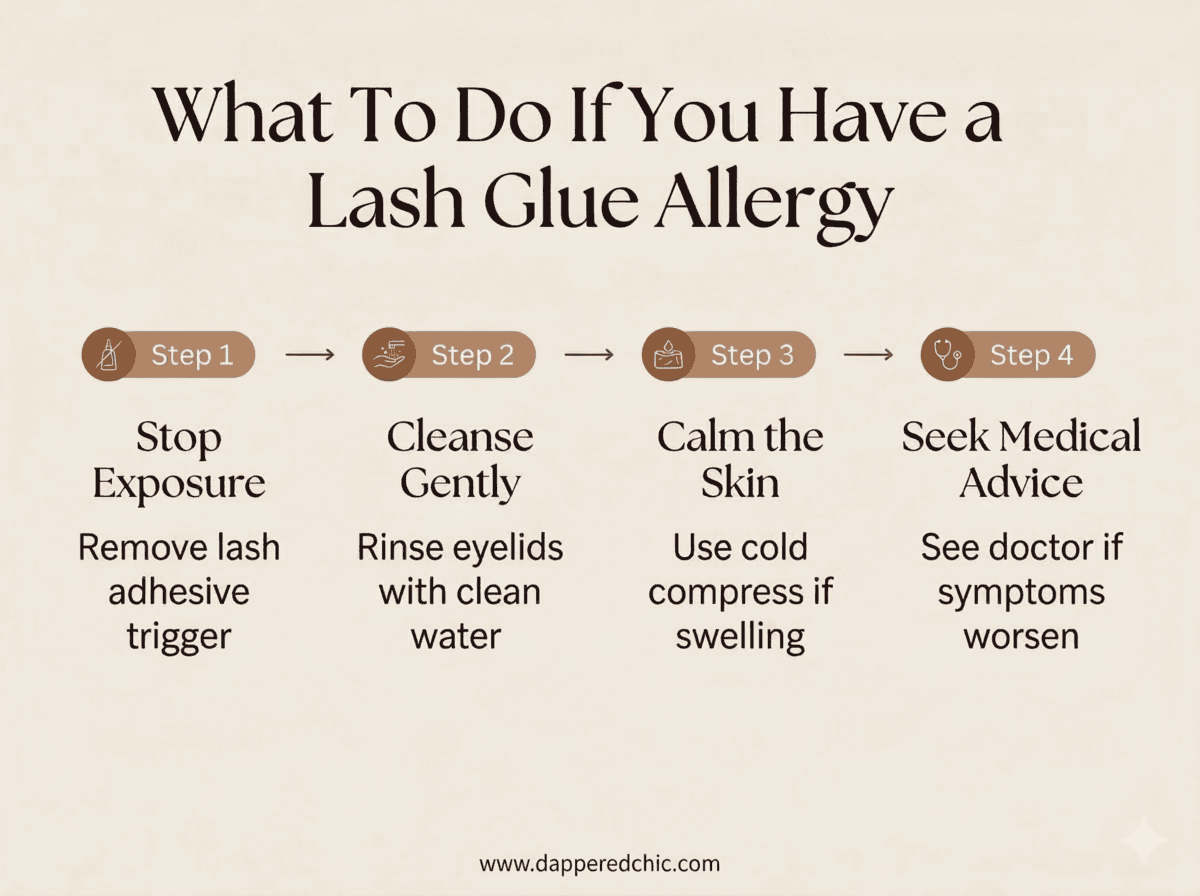
If your eyes start reacting after lash glue exposure, the goal is simple: stop further exposure, protect the eye area, and monitor symptoms carefully.
Most mild reactions improve once the trigger is removed. Acting early can help prevent irritation from becoming more severe.
Stop the Exposure
The most important first step is to avoid further contact with the adhesive.
That means:
- Do not apply more lash glue
- Do not test the same adhesive again
- Avoid rubbing or touching the irritated area
Rubbing can worsen inflammation around the eyelids and may spread adhesive residue closer to the eye surface.
Remove the Lashes Safely
If lash extensions are still attached and symptoms are worsening, removing the adhesive source may help reduce ongoing irritation.
However, never pull or rip extensions off yourself. This can damage natural lashes and irritate already sensitive skin.
Professional removal is usually safest because lash technicians use specialized removers designed to dissolve adhesive without pulling on the lash follicles.
📌 If you need guidance on the safe removal process, see how to remove eyelash glue.
Clean the Area Gently
Once the adhesive source is removed, keeping the eye area clean can help reduce further irritation.
Helpful steps include:
- Gently cleansing the area with a mild cleanser or saline solution
- Avoiding harsh rubbing
- Avoiding strong skincare products near the eyes while the skin is irritated
The goal is simply to remove adhesive residue and allow the skin barrier to calm down.
Calm Things Down While You Watch Symptoms
Many mild reactions improve once the irritant or allergen is removed.
Some people find relief with supportive steps such as:
- Using a cool compress to reduce puffiness
- Resting the eyes and avoiding makeup
- Taking an over-the-counter antihistamine if itching becomes uncomfortable
These steps can help relieve discomfort, but they are supportive measures rather than full medical treatment plans.
⚠️ Because the eyelid skin is extremely delicate, medicated creams or treatments around the eye area should only be used with medical guidance, especially if swelling or irritation becomes more intense.
If symptoms continue to worsen, medical guidance becomes important.
Know When Home Care Is Not Enough
Certain symptoms signal that the reaction may require medical evaluation.
⚠️ Seek medical care if you notice:
- Swelling that continues to worsen
- Symptoms spreading beyond the eyelid area
- Persistent redness or irritation that does not improve
- Significant eye pain
- Blurred vision or vision changes
These signs can indicate more serious inflammation around the eye that requires professional care.
🌐 According to the American Academy of Dermatology (AAD) and Mayo Clinic, contact dermatitis should improve after the trigger is removed. Persistent swelling, worsening irritation, or symptoms that do not improve may require medical evaluation.
🌐 According to the Cleveland Clinic, symptoms such as eye pain, vision changes, or severe swelling can signal a more serious eye problem and should be evaluated by a medical professional.
📌 If you need a deeper breakdown of medical treatment options, see how to treat eyelash glue allergy.
Who Is More Likely to Get an Eyelash Glue Allergy?
Anyone can develop a reaction to lash adhesive, but some people are more likely to experience sensitivity around the eye area.
Certain factors can increase the chances of irritation or allergic reactions.
People with sensitive skin or a history of reacting to cosmetics may notice symptoms sooner because their skin barrier tends to respond more strongly to potential irritants.
Frequent lash extension wear can also increase risk. Repeated exposure to adhesive ingredients gives the immune system more opportunities to become sensitized over time.
Some readers also notice more irritation if they:
- Wear contact lenses, which can make eyes feel drier or more reactive
- Already experience sensitive or easily irritated eyelids
- Have you reacted to cosmetic adhesives or acrylate-based products before
These factors do not mean someone will definitely develop an allergy. They simply mean the eye area may react more easily to ingredients commonly found in lash adhesives.
Understanding these patterns can help readers make more cautious decisions about lash services and eye-area products.
Can You Prevent It Next Time?
If you have reacted to lash adhesive before — or you are worried about it happening again — prevention usually focuses on reducing exposure and understanding your personal sensitivity triggers.
Some precautions can reduce risk, but no method can eliminate the possibility of an allergic reaction completely.
Patch Testing Helps, But It Is Not Foolproof
Patch testing is often recommended before lash extension services, especially for new clients.
During a patch test, a small amount of adhesive or a few extensions are applied to see whether the skin reacts. This can sometimes reveal sensitivity before a full appointment.
However, patch tests have important limitations.
Many eyelash glue allergies are delayed allergic responses, meaning symptoms may appear 48–72 hours later rather than immediately.
Patch tests also involve much smaller amounts of adhesive than a full set of extensions, which makes reactions harder to detect in advance.
Because of this, patch testing can reduce risk but cannot guarantee that a reaction will not occur.
“Sensitive” or Latex-Free Glue Can Lower Risk — But Not Remove It
Some lash adhesives are marketed as sensitive formulas, low-fume adhesives, or latex-free options.
These formulas may reduce irritation for some users, especially if adhesive vapors were the main trigger. However, they are not a complete solution for people with true adhesive allergies.
Most extension adhesives still rely on cyanoacrylate-based bonding agents, which are the ingredients most commonly associated with allergic reactions.
In other words, sensitive formulas may reduce irritation risk, but no cyanoacrylate-based lash adhesive can be considered truly allergy-proof once sensitization has developed.
Reduce Repeat Exposure If You’ve Already Reacted
If you have already experienced a reaction, repeatedly exposing your eyes to the same adhesive can increase the risk of stronger symptoms.
Instead of repeatedly testing the same glue, it is usually safer to reduce exposure and allow the eye area time to recover.
Repeated reactions may indicate that the body has become sensitized to adhesive ingredients, meaning future exposures could trigger more severe responses.
What Can You Use Instead If You’re Allergic to Lash Glue?
If lash adhesive continues to trigger reactions, the next step is often looking for alternatives that do not rely on traditional lash glue.
These options may not fully replicate lash extensions, but they can help readers maintain a lash-focused beauty routine with less irritation risk.
Magnetic Lashes
Magnetic lashes attach using small magnets instead of adhesive.
Some styles attach to a magnetic eyeliner, while others sandwich the natural lashes between two magnetic strips. Because they do not rely on lash glue, they can be a helpful option for people sensitive to adhesive ingredients.
However, they are not completely risk-free. Magnetic liners contain iron oxides, which may still irritate sensitive skin for some users.
There is also one important safety consideration.
⚠️ Caution: Magnetic lashes should always be removed before an MRI scan, because strong magnetic fields can pull metallic particles and interfere with imaging safety.
Tubing Mascara
Tubing mascara is another practical alternative.
Instead of coating lashes with traditional wax-based pigment, tubing formulas form tiny polymer tubes around each lash. These tubes resist smudging but remove easily with warm water.
For people who cannot tolerate lash adhesives, tubing mascara can provide length and definition without adhesive exposure.
Lash Serums or Other Lash Enhancement Options
Some readers choose to focus on natural lash conditioning and growth support instead.
Lash serums and conditioning treatments are designed to support stronger, healthier lashes over time. While they do not produce the immediate dramatic effect of extensions, they can improve the appearance and resilience of natural lashes.
For readers with sensitive eye areas, building a routine around gentle eye makeup and lash care may be a safer long-term approach.
📌 If your eyes react easily to cosmetics, see eye makeup for sensitive eyes.
Common Mistakes That Make Eyelash Glue Reactions Worse
When the eye area is already irritated or reacting, certain habits can make the situation worse without people realizing it.
Avoiding a few common mistakes can help prevent a mild irritation from turning into a stronger reaction.
Some of the most common problems include:
- Reapplying lash glue while the area is already irritated: Trying another set of extensions or testing the same adhesive again increases exposure and may trigger a stronger reaction, particularly if the immune system has already become sensitized.
- Using expired or degraded lash adhesive: Adhesives break down over time. As they degrade, they may release more irritating byproducts and fumes that can worsen eye sensitivity.
- Rubbing or scratching the eyelids aggressively: The skin around the eyes is extremely delicate. Repeated rubbing can increase swelling, inflammation, and irritation.
- Ignoring early warning signs: Mild itching or redness is sometimes dismissed as “normal.” But when symptoms persist or worsen, they may signal the beginning of an allergic reaction to lash adhesive.
Paying attention to these early signals can often prevent a minor irritation from becoming a more serious eye-area reaction.
FAQs About Eyelash Glue Allergy
❓Can an eyelash glue allergy go away?
In some cases, mild reactions improve once the adhesive is removed and the skin has time to recover.
However, true allergic sensitization can persist. Once the immune system recognizes an ingredient as a trigger, future exposures may cause reactions again.
Because of this, many people who develop eyelash glue allergies eventually avoid adhesive-based lash extensions.
❓Are lash extensions safe if you’ve already reacted?
If you have experienced a clear allergic reaction before, repeating the same exposure can increase the risk of another reaction.
Some people try different adhesives or “sensitive” formulas, but success varies. For readers who have experienced stronger reactions, reducing or avoiding adhesive-based lash extensions is usually the safest option.
❓Can “sensitive” lash glue still cause allergies?
Yes. “Sensitive” adhesives may reduce fumes or irritation, but they still typically rely on cyanoacrylate bonding agents.
Because of that, they can still trigger allergic reactions in people who are already sensitized to those ingredients.
❓Is eyelash glue allergy dangerous?
Most reactions affect the skin around the eyelids and improve once exposure stops.
However, symptoms involving severe swelling, severe pain, or vision changes should be taken seriously. When the eye itself becomes involved, medical evaluation is important to protect eye health.
Key Takeaways
Eyelash glue allergies are real, and they can happen even to people who have worn extensions for a long time without problems.
The most important points to remember are:
- Irritation and allergy are not the same thing
- Allergic reactions often appear later, sometimes days after a lash appointment
- Reactions can develop after past tolerance due to sensitization
- Severe symptoms should never be ignored, especially if the eye itself becomes involved
- If lash glue continues to trigger reactions, safer alternatives do exist
Understanding how eyelash glue reactions develop can help you recognize warning signs earlier, protect the eye area, and make safer decisions for future lash routines.
🎁 Before You Move On
Eye irritation after lash glue can sometimes overlap with other lash-related problems. If you are still trying to figure out what your eyes may be reacting to, these guides may help narrow it down.
You may also want to read:
- 📌 Swollen eyelids after eyelash extensions
- 📌 Why is my eyelash line itchy
- 📌 Eyelash extension problems
- 📌 Eyelash infection symptoms