
⚡ TL;DR: best eyeshadow brushes
A useful eye-brush lineup does not need to be large. We get more mileage from pairing one versatile blender with shapes that press on color, keep crease work contained, and handle detail; from there, we can add a specialist only when a recurring makeup job calls for one.
Top Picks
- 🏆 Best Overall — ILIA Blending Brush — versatile tapered control
- 🥈 1st Runner-up — Sigma E55 — dense controlled payoff
- 🥉 2nd Runner-up — EcoTools Dual-Ended Eye Brush — two jobs, one handle
A full brush cup can make a simple eye look feel unnecessarily technical. The best eyeshadow brushes give us predictable control through their geometry: denser heads concentrate placement, softer heads spread and soften pigment, and smaller heads trade speed for precision.
So what deserves space in a streamlined kit? We are keeping this guide centered on practical roles rather than cataloging every possible brush type, with the goal of covering the jobs we actually repeat.
✨ Inside This Eye Shadow Guide
🌸 Psst…
Some links in this post are affiliate links. If you shop through them, we may earn a small commission at no extra cost to you — like a little coffee while we keep testing beauty favorites. ☕💄
Quick Comparison: Best Eyeshadow Brushes
Which pick matches the job at hand? This table keeps the comparison centered on head design and supported formula fit, rather than treating every eye brush as interchangeable.
| Product | Best For | Head Shape | Formula Fit |
|---|---|---|---|
| ILIA Blending Brush | Overall versatility | Tapered blending head | General eyeshadow use |
| e.l.f. Eyeshadow C Brush | Budget-friendly placement | Curved synthetic head | Wet or dry use |
| Sigma E55 | Cream/powder placement | Soft, dense shader | Cream and powder |
| EcoTools Dual-Ended Eye Brush | Two-step application | Flat + fluffy dual ends | Cream, liquid, powder |
| e.l.f. Crease Brush | Controlled crease work | Compact crease head | Eyeshadow |
| Sigma E28 | Detail blending | Small rounded buffer | Cream, liquid, metallic |
| Sigma E20 | Packing and smudging | Short, flat shader | Powder plus reported cream/liquid use |
| Sigma E25 | One-brush multitasking | Rounded, slightly flattened blender | Eyeshadow |
How to Match a Brush to the Job
What changes first when two brushes look similar at first glance? Density controls payoff is the simplest rule we can carry into shopping: shorter or denser bristles tend to keep pigment concentrated at the contact point, while softer, fluffier heads spread color farther and blur hard edges.
That is how a shader and a blender can both belong to the same broad “eyeshadow brush” category yet behave very differently. Flat or compact heads favor placement; rounded or tapered heads favor gradual edge softening.
We do not need a full brush taxonomy to make the choices in this roundup. When we want the deeper map of shader, crease, pencil, smudge, and other shapes, the dedicated guide is the cleaner place to unpack those categories.
The difference is practical: memorizing shape names is not the same as deciding which roles our own routine is missing. Once we are ready to move beyond these core jobs, the separate guide helps decode less familiar brush styles.
Scale matters in blending just as much as softness does. A large fluffy head can blur a hard edge quickly, whereas a smaller domed or tapered head keeps the working area tighter when we want crease color to stay contained.
When shadow keeps moving higher than intended, brush size can be part of the problem rather than technique alone. The technique guide goes deeper on pressure, placement, and edge diffusion once the tool itself fits the job.
Cream and liquid formulas introduce another variable. Synthetic fibers appear throughout this group, but we only describe a brush as wet-formula friendly when the verified product information specifically supports that use.
Best Eyeshadow Brushes
Why eight different picks instead of eight similar blenders? Each slot solves a separate brush job, so the lineup covers placement, diffusion, crease control, detail work, and multitasking without pretending one shape does every task equally well.
ILIA Blending Brush
Best Overall — versatile blend-and-place control
A tapered synthetic head gives us softness for blending while keeping the contact area more controlled than a broad fluffy brush.
For a collection built around one dependable starting brush, that balance is useful. The tapered profile can move around the lid and crease without feeling locked into one narrow specialty, while still keeping placement more deliberate than a very large blender.
That versatility is what earns the top slot. We can use one general tool for placing and softening color, then add a true packer or lash-line specialist only when those more exact jobs start showing up in the routine.
Bottom line: Tapered control without over-specializing. This is our strongest all-around option when we want a capable first brush with room to add specialists later.

- ✅ A tapered profile keeps blending more controlled around the eye.
- ✅ Synthetic bristles fit neatly into a practical, easy-care collection.
- ✅ Broad versatility makes it a sensible anchor for a smaller kit.
- ❌ Very dense lid packing still calls for a more specialized head.
- ❌ Close lash-line work is easier with a shorter dedicated detail brush.
🧪 Lash Lab Notes — Engr. Nusrat (Engineer & Beauty Enthusiast)
A tapered shape reduces the working area while preserving the soft edge needed for blending. That balance lets one tool shift between placement and diffusion without pushing color as far as a larger fluffy head might.
- 💡 Editor’s Note: We see this as the brush that can live at the center of a compact collection. It does not replace every specialist, but it can reduce how often we need to switch tools for small adjustments.
Curious how buyers describe that balance in daily use? See the latest reviews for ILIA Blending Brush.
We would start here when one adaptable eye brush needs to come before more specialized shapes.
Care tip: We keep reusable bristles clean with gentle washing and allow the brush to dry thoroughly before reuse.
As a first purchase, it covers a lot of ground; denser and smaller heads can wait until a clear gap appears.
e.l.f. Eyeshadow C Brush
Best Budget — useful control at a lower price tier
A curved synthetic head keeps the price modest without giving up the firmness needed to pick up and place shadow with intent.
Budget only matters if the brush still has a recognizable job. In the verified product record, customer feedback repeatedly points to soft bristles, useful color pickup, and workable blending, which gives this inexpensive option more purpose than a generic extra brush.
The curved shape can cover broad lid placement and some crease work, so we get more flexibility than a one-note bargain tool. Supporting product information also allows wet-or-dry use, widening the situations where this brush can earn its place.
Bottom line: A budget brush that still has a job. We like it for practical lid placement and light blending when a prestige handle is not the priority.

- ✅ Soft synthetic bristles still have enough firmness to lift and place shadow.
- ✅ The shape handles all-over lid color plus basic blending work.
- ✅ Strong value feedback supports it as a sensible low-cost individual brush.
- ❌ Very small detail zones are easier with a compact precision head.
- ❌ Wide, airy edge diffusion is faster with a true fluffy blender.

🧪 Lash Lab Notes — Fauzia (University Student & Beauty Enthusiast)
A lower-priced tool is especially useful when its shape still produces repeatable placement. This curved head covers enough common lid work that we can learn which specialty job is actually missing before buying more brushes.
- 💡 Editor’s Note: We would rather have one inexpensive brush with a defined role than several low-cost brushes that all behave the same way. A predictable job is what makes the savings useful.
Want a broader sense of how the brush performs for buyers? Check current reviews for the e.l.f. Eyeshadow C Brush.
We would choose it for low-cost everyday lid color with some light blending flexibility.
Care tip: We wash it gently, keep prolonged soaking away from the ferrule, and let the brush dry fully.
This slot proves that price can be the filter without making performance the afterthought. For a broader budget comparison, the dedicated guide looks beyond this single inexpensive pick.
It works well as an affordable companion to a blender, or as an early purchase when cost comes first.
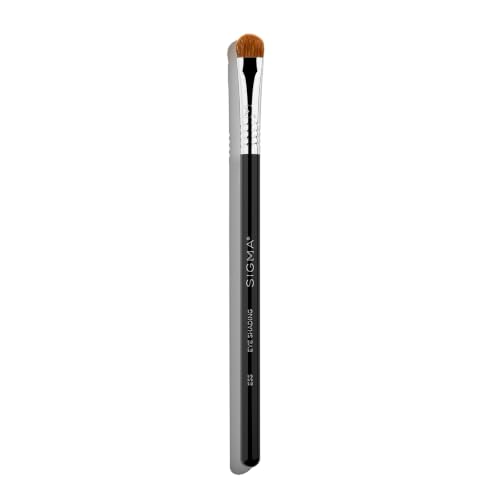
Sigma E55 Eye Shading Brush
Best for Cream & Liquid Shadow — dense controlled placement
A soft, dense shader keeps pigment concentrated over the lid instead of turning the first pass into a diffused wash.
Why can creamier formulas look underwhelming with the wrong brush? An overly airy head can spread product before enough of it lands. The E55 provides more surface density, letting us press on a controlled layer first and soften the perimeter afterward with a different motion.
The verified record supports cream and powder use, while customer feedback repeatedly highlights color pickup, straightforward application, and a size that covers the lid efficiently. That broader usefulness does not change the reason it wins this slot: controlled placement comes first.
Bottom line: Dense placement for stronger payoff. We reach for this when cream, liquid, or powder shadow needs more concentrated lid coverage than a fluffy blender provides.
- ✅ Dense synthetic fibers support stronger pickup and controlled pigment placement.
- ✅ Verified use covers both cream and powder eyeshadow application.
- ✅ The head is large enough for efficient lid coverage without becoming oversized for the eye area.
- ❌ Very soft transition edges still benefit from a fluffier blending brush.
- ❌ Tight inner-corner or lash-line work is easier with a smaller detail head.
🧪 Lash Lab Notes — Dr. Rabeya (Dentist & Beauty Enthusiast)
With wetter formulas, a denser synthetic head can establish clean placement before the edge is disturbed. Treating placement and diffusion as separate motions can make the finished result easier to control.
- 💡 Editor’s Note: We value this specialist because it addresses a specific problem: weak or patchy placement from a brush that is too fluffy. Blending can happen afterward; first we need enough product to land where it belongs.
Wondering how that dense shape translates in real routines? Read recent reviews for the Sigma E55.
We would use it when concentrated lid payoff matters more than airy diffusion.
Care tip: We clean the synthetic fibers gently, reshape the head, and lay the brush flat to dry.
The next option keeps placement and softening distinct too, but combines both jobs on one handle.
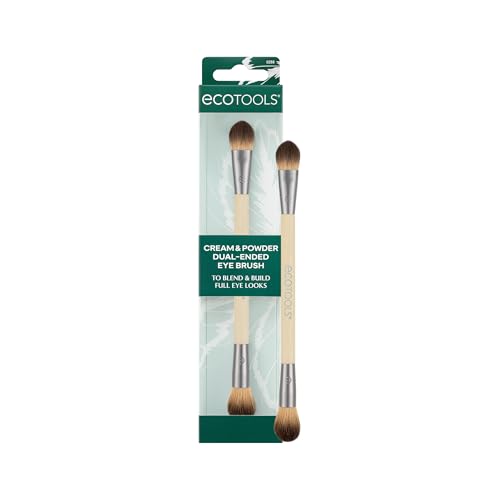
EcoTools Cream & Powder Dual-Ended Eye Brush
Best Dual-Ended — two complementary eye jobs on one handle
A flat end handles placement while a fluffy end handles diffusion, so both sides of the handle have a clearly different purpose.
What makes a dual-ended brush genuinely useful rather than merely compact? The two ends need to solve different problems. Here, the flat side supports cream or liquid placement, while the fluffier side can soften cream or powder, matching the natural sequence of apply first and diffuse second.
That pairing suits travel, smaller makeup bags, or routines where we would rather not change handles mid-look. The verified customer summary also points to very soft bristles and solid everyday application performance.
Bottom line: Two real jobs, not two decorative ends. We would pick it when compactness matters and one handle needs to cover both placement and blending.
- ✅ The flat and fluffy ends perform genuinely different application jobs.
- ✅ Supported use spans cream, liquid, and powder eye-product routines.
- ✅ Soft synthetic bristles and a bamboo handle make the tool practical for regular use.
- ❌ Dual-ended storage can be awkward when a cup or case presses one brush end against a surface.
- ❌ Very small crease or lash-line work still benefits from dedicated precision specialists.
🧪 Lash Lab Notes — Engr. Nusrat (Engineer & Beauty Enthusiast)
The useful design choice is functional separation: one end concentrates product while the other diffuses it. That is more practical than forcing one head to behave as both a dense flat applicator and a broad fluffy blender.
- 💡 Editor’s Note: We would buy this for efficiency rather than assuming every dual-ended brush is automatically better. The advantage is that its two heads mirror two steps we already perform, which makes the format meaningfully compact.
Want to know whether buyers find both ends equally useful? See current reviews for the EcoTools Dual-Ended Eye Brush.
We would choose it when cream/powder flexibility matters more than carrying separate handles.
Care tip: We clean both ends regularly, avoid prolonged ferrule soaking, and lay the brush flat while it dries.
When the harder problem is keeping color inside the crease, a more focused head makes the next choice clearer.
e.l.f. Crease Brush
Best Controlled Crease — smaller-area placement and diffusion
A compact synthetic crease head gives up some broad blending speed in exchange for a tighter working area.
When color keeps drifting above the socket, simply using a large brush more gently may not solve the issue. A smaller footprint can keep placement and softening more contained, which is exactly what this e.l.f. shape is built to do around the crease.
The verified record also carries consistently positive feedback on softness, value, and effective blending. That helps this feel like an accessible problem-solver rather than a niche brush reserved for advanced routines.
Bottom line: A smaller working radius for the crease. We prefer it when controlled blending matters more than maximum diffusion speed.

- ✅ A compact crease-focused shape helps localize color more precisely.
- ✅ Soft synthetic bristles suit repeated blending passes around the crease.
- ✅ Strong value feedback makes a specialized shape easier to add without overspending.
- ❌ A larger blender is quicker for sweeping a sheer transition across a broad area.
- ❌ Full-lid shimmer packing is better handled by a denser shader.
🧪 Lash Lab Notes — Mahmuda (Homemaker & Beauty Enthusiast)
A smaller crease head can be easier to keep inside the area we actually want to deepen, especially when a large fluffy brush spreads color too quickly. That extra control can make everyday blending feel simpler rather than more technical.
- 💡 Editor’s Note: We treat this as a fix for a recurring placement problem, not as a compulsory brush shape. If our current blender already stays where it belongs, another tool may add little; if color keeps creeping upward, changing the geometry makes sense.
Curious how buyers describe its control and softness? Check the reviews for the e.l.f. Crease Brush.
We would use it when crease precision is harder to maintain with a larger blender.
Care tip: We use a mild cleanser, reshape the bristles, and let the brush dry flat.
For even tighter corrections and localized buffing, the next pick reduces the working area again.
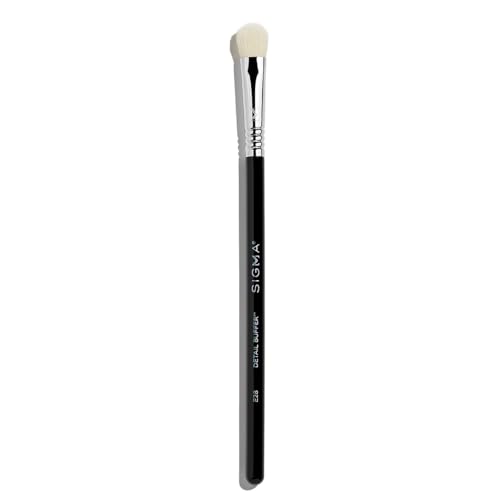
Sigma E28 Detailed Buffer Brush
Best Detail Blender — small-area edge softening and precision
A compact rounded buffer gives us a way to soften one small edge without disturbing everything around it.
When does a detail brush become worth adding? Usually after the broader look is already in place. The E28 can buff cream or liquid shadow in smaller areas, pack metallic shades, and work around the brow bone, so its strength is precision rather than coverage speed.
That same scale can help when a larger brush has over-blended the look. Instead of diffusing even more area, we can re-place depth or polish a confined edge with a smaller footprint.
Bottom line: Precision for fixes and small zones. We like it when larger blending brushes feel clumsy around the outer corner, brow bone, or other confined areas.
- ✅ The small rounded head is designed for localized buffing work.
- ✅ Verified use includes cream or liquid shadow plus metallic packing.
- ✅ A compact footprint helps refine a nearly finished look without disturbing the full lid.
- ❌ Broad transition washes take longer with a head this small.
- ❌ Routines that rarely use layered or detailed eye looks may not need this specialization.
🧪 Lash Lab Notes — Zayba (A-Level Student & Beauty Enthusiast)
A compact detail head gives us another option after a larger brush has softened too much of the look. Rebuilding depth in one corner can be easier than trying to reconstruct the full gradient.
- 💡 Editor’s Note: This is the kind of specialist that becomes valuable after the basics are already covered. We would add it when there is a recurring precision problem to solve, because fine control matters most once the larger placement and blending jobs are working.
Want more buyer impressions before adding a detail specialist? Browse current reviews for the Sigma E28.
We would reserve it for outer corners, metallic placement, and other compact blending zones.
Care tip: We clean it gently, dry it thoroughly, and avoid flattening the rounded head while it is wet.
The next Sigma goes shorter and flatter, moving the priority from buffing toward concentrated placement.
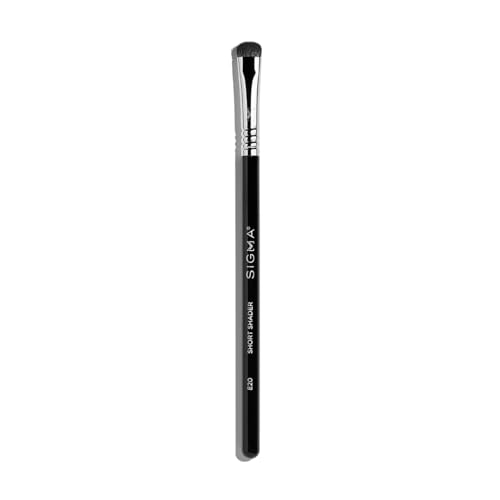
Sigma E20 Short Shader Brush
Best for Packing Color — short, flat concentrated placement
A short flat shader with tightly packed synthetic fibers keeps pigment close to the exact point where the brush meets the skin.
Why does bristle length matter when payoff is the goal? Extra flex can scatter pigment instead of pressing it down. The E20’s shorter build favors concentrated application, and verified product feedback also supports using it to smudge shadow or liner near the lash line.
Those uses share the same strength: keeping color tight rather than letting it spread. It is not meant to haze a transition shade across a wide socket, and that narrower purpose is exactly what makes the brush useful here.
Bottom line: Short bristles keep pigment concentrated. We choose it for lid packing, lash-line smudging, and other small zones where broad diffusion would weaken the effect.
- ✅ A short, flat head keeps color placement precise.
- ✅ Tightly packed fibers support concentrated application as well as smudging.
- ✅ Customer feedback points to soft bristles, good control, and useful versatility across multiple formulas.
- ❌ A fluffy brush remains the better tool for a seamless wide transition.
- ❌ Full-lid coverage is slower with this compact head than with a larger shader such as the E55.
🧪 Lash Lab Notes — Engr. Nusrat (Engineer & Beauty Enthusiast)
Shorter bristles flex less before transferring product, so color stays nearer the contact point. That makes this geometry useful when payoff or definition needs to remain concentrated instead of diffusing immediately.
- 💡 Editor’s Note: We would add this after a general blender rather than before one. The shape has a narrow, obvious purpose, and that purpose becomes especially useful when shimmer looks faint or lash-line shadow keeps turning into a wider smoky effect.
Does that compact working area fit the looks we make often? Check reviews for the Sigma E20.
We would use it when concentrated color matters more than fast coverage.
Care tip: We wash it gently, reshape the short bristles, and let the brush dry completely before using it again.
For a routine built around fewer tools, the last pick trades some specialization for broader everyday flexibility.
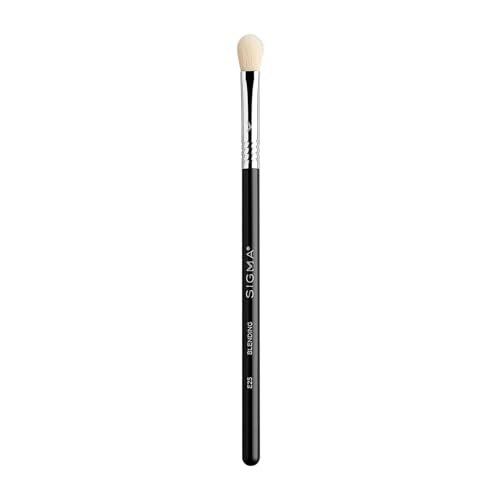
Sigma E25 Blending Brush
Best One-Brush Multitasker — shade and soften with one tool
A rounded, slightly flattened blender can use its broader side to lay down a wash, then its tip to soften the edge.
This slot is not a repeat of Best Overall; the goal here is intentional minimalism. For a simple one- or two-shadow routine, the E25 balances firmness and softness well enough to move between placement and blending more naturally than a purely fluffy transition brush.
The verified customer summary strongly favors its blending ability and daily versatility. It also records mixed feedback on long-term shape retention and bristle shedding, which matters when one brush is expected to absorb frequent daily use.
Bottom line: Place, then soften, with one head. We see the strongest fit when minimizing tools matters more than maximizing specialist precision.
- ✅ The rounded, slightly flattened profile supports both application and blending.
- ✅ Soft bristles retain enough firmness for controlled everyday work.
- ✅ Customer feedback strongly supports its versatility in daily eye makeup.
- ❌ Mixed long-term shape-retention feedback may matter when the brush is used heavily every day.
- ❌ Some buyers report bristle shedding, while others report none.
- ❌ A short shader or compact detail brush still gives tighter control for the most specialized jobs.
🧪 Lash Lab Notes — Fauzia (University Student & Beauty Enthusiast)
A slightly flattened blender can use its broader face for a wash and then turn so the tip softens the boundary. That is practical in quick routines where carrying fewer tools matters more than owning the perfect specialist for every step.
- 💡 Editor’s Note: We would choose this when simplicity itself is the buying goal. One capable multitasker can speed up a routine, but we still accept that the densest packing and tiniest detail jobs will not be as exact as they are with dedicated shapes.
How do buyers weigh that versatility against the durability notes? Read the reviews for the Sigma E25.
We would keep it for simple daily looks where one adaptable brush is more useful than several specialists.
Care tip: We clean gently, avoid tugging at the bristles, and reshape the head before drying it flat.
With the individual roles covered, the remaining decision is how many of them belong in our own kit.
How to Build a Small Eye-Brush Kit
How small can a useful kit stay? We would start with jobs rather than a target number: one versatile blender handles simple washes and softened edges, then a denser shader adds the concentrated placement a fluffy head cannot deliver as well.
The next addition should solve the problem we notice most often. If color travels too high, a crease brush makes sense; if small lash-line, outer-corner, or metallic areas are harder to control, a detail brush earns the slot instead.
A practical three-role starter kit:
- One versatile blender for laying down washes and softening their edges.
- One dense shader for concentrated lid placement and stronger payoff.
- One crease or detail brush chosen around the control problem that shows up most often.
Once those roles are covered, another brush should fix a real inconvenience rather than simply make the collection larger. Three clearly different shapes can be more useful to a beginner than a bigger set full of near-duplicates.
After the tools are chosen, sequence becomes the next skill to learn. A dedicated application walkthrough shows how placement and blending can work together as a repeatable full-eye routine.
Reusable brushes also perform better when old pigment and oils are not allowed to build up indefinitely. Gentle washing and complete drying matter, while the full maintenance process is better handled in its own step-by-step guide than squeezed into a shopping section.
When we want the cleaning order, drying method, and care details together, the maintenance guide is the better next stop. It keeps brush upkeep separate from the buying decision once the lineup itself is settled.
Common Questions About Eye Brushes
What still tends to be unclear after the role-by-role picks? These answers stay focused on how much specialization we actually need, while leaving deeper technique and audience-specific shopping questions to their dedicated guides.
❓ If I buy only one eyeshadow brush, what shape should it be?
Answer: We would start with a versatile rounded or tapered blender that is firm enough to lay down a light wash and soft enough to blur the edge. A multitasker such as the Sigma E25 makes sense when one tool is the goal; denser shaders and smaller detail heads become more useful only when stronger placement or tighter control is needed.
❓ Are smaller brushes better for hooded or smaller eyes?
Answer: Smaller domed or detail heads can help keep shadow inside a tighter working area, but size alone does not make every small brush better for every hooded eye. Eye shape, usable lid space, and the look we are building still change which head feels most controlled.
General guidance has limits when lid and crease space vary so much from one person to another. The hooded-eye roundup treats that tighter placement problem as the main criterion rather than a side note.
❓ Should I buy individual eyeshadow brushes or a set?
Answer: We would buy individual brushes when the missing jobs are already clear and choose a set when several coordinated roles are needed at once and the included shapes match the routine. A higher piece count adds little when multiple heads duplicate the same function.
If a prebuilt kit sounds easier than assembling brushes one by one, the useful comparison is set versus set rather than one standout brush versus another. The dedicated roundup looks at how the pieces work together as a bundle.
❓ Do I need a special brush for cream or liquid eyeshadow?
Answer: We need a brush whose verified design supports the formula, not merely one made with synthetic fibers. Dense placement shapes such as the Sigma E55 and the flat side of the EcoTools dual-ended brush are useful when wet or creamy product needs controlled placement before the edge is softened.
Final Thoughts: Buy by Job, Not Brush Count
What makes a brush collection feel complete? For us, every handle needs a reason to exist: a versatile blender establishes the base, a denser shader adds payoff, and a smaller crease or detail brush earns space only when tighter control solves a real problem.
That rule is more useful than filling a brush cup and hoping one shape eventually matches the job. Buy by job and head shape, then let the routine reveal which specialist deserves to come next.
Last update on 2026-09-27 / Affiliate links / Images from Amazon Product Advertising API