
⚡ TL;DR: revitalash advanced eyelash conditioner reviews
Both RevitaLash formulas covered here list ethylcloprostenolamide as a prostaglandin analogue. So the real choice is Advanced versus Advanced Sensitive—not prostaglandin versus prostaglandin-free.
What should we focus on when reading revitalash advanced eyelash conditioner reviews? Whether the standard or sensitivity-oriented formula fits our needs and risk tolerance better.
We are keeping this comparison tight: two verified RevitaLash products, their formula differences, evidence quality, eye-area cautions, and ongoing cost.
✨ Inside This Lash Guide
🌸 Psst…
Some links in this post are affiliate links. If you shop through them, we may earn a small commission at no extra cost to you — like a little coffee while we keep testing beauty favorites. ☕💄
What Changed in the Covered RevitaLash Advanced Formulas
Why does version control matter here? RevitaLash says Advanced was reformulated in December 2024.
That means older package labels or other-market ingredient lists should not automatically stand in for the current U.S. formula.
For the two products covered here, both current U.S. formulas list a prostaglandin analogue. So Advanced Sensitive is not the prostaglandin-free version of Advanced.
Its real difference is the supporting formula and sensitivity positioning.
Advanced is the standard formula. Advanced Sensitive adds ingredients such as Myristoyl Pentapeptide-17, hydrolyzed rice protein, aloe vera, and amino acids and is marketed for sensitive eyes.
So what is the practical decision? Standard formula versus sensitivity-oriented support—not a change in prostaglandin-analogue status.
Which RevitaLash Advanced Formula Fits You?
Both products use a once-daily upper-lash-line routine. That keeps application similar, while formula role, tolerance priorities, evidence quality, and price do the real decision-making.
Is there one universal winner? No. The better fit depends on what we are trying to optimize.
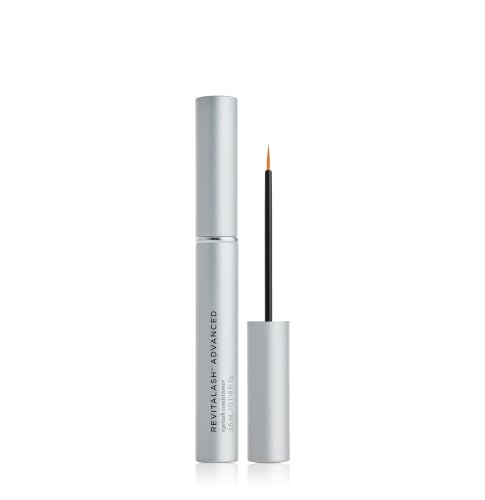
RevitaLash Advanced
Want the classic RevitaLash route with broader size options? The standard formula is the straightforward choice.
RevitaLash reports a 157-participant, eight-week consumer study in which 94% experienced improved lash appearance.
It also sells a 3.5 mL size the brand estimates at about six months of use, plus a 2.0 mL size estimated at about three months.
💡 Dappered Chic Note — Fauzia (University Student & Beauty Enthusiast)
I treat The Independent’s Anita Bhagwandas report as a useful reference point. She described easy application and lashes that looked more conditioned, thicker, and longer after about six weeks, but that is still one editorial account rather than controlled proof.
Bottom line: Best for the standard formula when we accept the prostaglandin-analogue ingredient and premium ongoing cost.
- ✅ Gives us the standard RevitaLash formula with several consumer size options
- ✅ Keeps the routine simple with once-daily precision application
- ✅ Makes the formula and use directions clear in current documentation
- ❌ Does not fit a prostaglandin-analogue-avoidance goal
- ❌ Premium ongoing cost can work against a budget-first choice
- ❌ Product-specific results evidence leans mainly on consumer-perception data

🧪 Lash Lab Notes — Engr. Nusrat (Engineer & Beauty Enthusiast)
What stands out to me is the fine applicator, thicker liquid, and one-dip-for-both-eyes direction. Together, they point to one practical rule: precision matters more than volume, because a heavier stripe works against the intended narrow-line application.
- 💡 Editor’s Note: We trust the product identity, application directions, and current-label facts most. The results evidence can help set expectations, but it is not definitive clinical proof.
Want a quick check on current buyer feedback before we decide? See RevitaLash Advanced reviews.
Pick it when the standard formula is the goal and a prostaglandin-analogue ingredient is acceptable.
More worried about eye-area sensitivity? The next formula changes the supporting ingredient story.
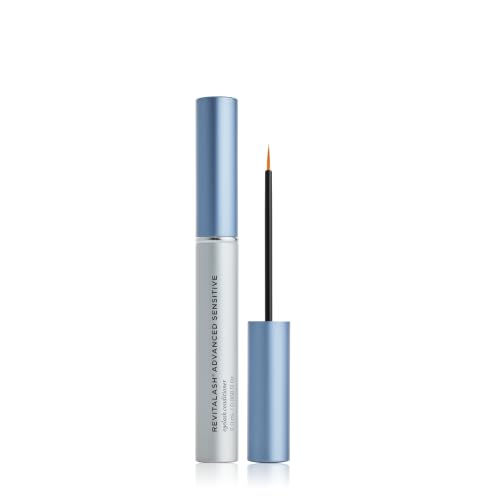
RevitaLash Advanced Sensitive
The sensitivity-oriented formula changes the support system around the decision, not the prostaglandin-analogue status.
RevitaLash positions this 2.0 mL formula for sensitive eyes and highlights Myristoyl Pentapeptide-17, hydrolyzed rice protein, aloe vera, amino acids, and Revitasome technology.
Still, its current U.S. ingredient list names ethylcloprostenolamide as a prostaglandin analogue.
What does the brand’s study say? It reports an eight-week study of 154 self-reported sensitive-eye or sensitive-lash participants. That includes 90% saying lashes looked more nourished, 84% saying it did not cause redness, and 79% saying it did not cause irritation.
Those are commissioned perception results, not a clinical safety guarantee.
Bottom line: Best for sensitivity-oriented support within RevitaLash when a prostaglandin-free formula is not required.
- ✅ Sensitive-eye positioning with a supporting formula for irritation-prone users
- ✅ Fragrance-free and oil-free positioning makes the same-brand choice clearer
- ✅ Same once-daily precision routine as standard Advanced
- ❌ Fails if “sensitive” must also mean prostaglandin-free
- ❌ Tolerance percentages cannot promise zero redness or irritation
- ❌ 2.0 mL still comes with a premium ongoing price
🧪 Lash Lab Notes — Dr. Sazia (Medicine Specialist & Beauty Enthusiast)
I read “Sensitive” as a change in the supporting formula and target user, not a reason to dismiss redness, irritation, dry-eye concerns, or other eye conditions. The current formula still lists ethylcloprostenolamide and carries eye-area cautions, so those concerns still matter.
- 💡 Editor’s Note: The helpful distinction is formula support, not a promise of zero irritation. That keeps the sensitivity positioning useful without letting the label claim more than the evidence.
Wondering how buyers are responding to the sensitivity-focused version? See RevitaLash Advanced Sensitive reviews.
Choose it for sensitivity-oriented support, not when a prostaglandin-free formula is required.
What if sensitivity matters more than staying loyal to RevitaLash? A broader comparison can help us look at genuinely different formulas instead of treating one same-brand label as the whole category.
Now that the product roles are clear, what does the evidence actually prove?
What the Results Evidence Actually Shows
RevitaLash’s studies give us a useful time window, but they do not settle efficacy on their own.
Advanced has an eight-week, 157-participant consumer study with a 94% improved-appearance claim. Advanced Sensitive has an eight-week, 154-participant sensitive-eye/lash study with perception-based appearance and tolerance measures.
What about real-world editorial context? A named Independent beauty writer reported easy application and lashes that looked more conditioned, thicker, and longer after roughly six weeks using Advanced.
That helps with context. It is still one editorial experience rather than controlled evidence.
RevitaLash’s product-specific studies run eight weeks, while the named editorial observation showed visible change around six weeks. That gives us a rough expectation, not a category-wide timeline.
Where is the stronger clinical literature? It is stronger for other prostaglandin analogues, especially prescription bimatoprost.
According to PubMed/NIH, pooled bimatoprost trials provide safety data for that ingredient. Those numbers should not be transferred to RevitaLash.
Lash serums can use different ingredient strategies. So the strongest evidence for one prostaglandin analogue cannot simply be transferred to every cosmetic serum.
That evidence hierarchy matters even more once we move from results to safety.
Prostaglandin Analogue Risks and Safety Context
Both covered formulas list ethylcloprostenolamide as a prostaglandin analogue.
What reactions does RevitaLash report? The brand lists temporary redness, swelling, itching, burning, dry eyes, watering, styes, lash-line skin darkening, periorbital fat loss, and eyelash loss, while stating that causality is not established.
For Advanced, RevitaLash says that from September 2024 through August 2025, 0.11% of users reported the most common reaction as irritation.
That number needs context. It is not an incidence rate for every listed reaction, and it is company user-report data rather than an independently adjudicated clinical rate.
The TFOS Lifestyle review discusses prostaglandin-analogue effects and the limited direct evidence for many over-the-counter cosmetic lash products.
A separate PubMed/NIH paper supports a class-level concern around prostaglandin-associated periorbital volume change, but not a RevitaLash-specific incidence.
And the 2026 European SCCS opinion? It assessed three specifically named prostaglandin analogues and did not directly name current-U.S.-label ethylcloprostenolamide.
So we should not present it as a direct chemical ruling on the current U.S. RevitaLash formula without a verified identity bridge.
RevitaLash’s cautions say not to use on damaged or irritated skin, during pregnancy or nursing, or while undergoing treatment for glaucoma or cancer. It also does not recommend use with dry eyes, eye infections, styes, or other eye-related disorders.
When those cautions are relevant, follow the product label and clinician guidance.
Is the ingredient class itself the deal-breaker? Then the next move is a different shopping question, and a category guide can compare formulas positioned around avoiding prostaglandin analogues.
Once the risk context is clear, the application routine is simple.
How to Use RevitaLash Advanced Correctly
The routine is short, but precision matters. More serum is not the goal.
What is the brand asking us to do? Use a thin upper-lash-line application and give it time to dry.
Step 1: Begin with clean, dry upper lashes.
Remove makeup and moisture first so the line reaches clean skin at the lash base.
Step 2: Draw one thin line just above the upper lash line.
Keep it narrow instead of painting on a thick band.
Step 3: Use one dip for both eyes and keep it sparse.
RevitaLash says one dip is intended for both eyes, reinforcing the use-sparingly instruction.
Step 4: Let it dry for 2–3 minutes.
Give the product time to set before adding other eye-area products.
These directions are specific to RevitaLash, not a complete tutorial for every serum format.
Why does broader technique still matter? Applicators and formulas change across brands.
With the routine settled, one practical question is left: what does that daily habit cost over time?
Is RevitaLash Advanced Worth the Cost?
Sticker price is only part of the story. A larger tube can cost more upfront but work out cheaper over time, so the better comparison is what each option may cost per month based on the brand’s estimated supply duration.
Prices also move. Retailer pricing, promotions, and availability can change throughout the year, so I would not treat any single number as permanent. The ranges below are simply a practical way to compare the formulas rather than a promise of what you will pay today.
| Formula | Size | Brand Supply Estimate | Typical Price Range | Approx. Monthly Cost |
|---|---|---|---|---|
| RevitaLash Advanced | 3.5 mL | ~6 months | ~$150–$165 | ~$25–$28/month |
| RevitaLash Advanced | 2.0 mL | ~3 months | ~$100–$120 | ~$33–$40/month |
| RevitaLash Advanced Sensitive | 2.0 mL | ~3 months | ~$105–$120 | ~$35–$40/month |
Prices can vary by retailer, promotion, and time. These ranges are included for general comparison only and may not match the price you see when you shop.
On those estimates, the 3.5 mL RevitaLash Advanced generally gives you the lowest monthly cost. You pay more upfront, but the longer claimed supply helps spread that cost over more months.
Advanced Sensitive comes out a little higher on a monthly basis, but that does not automatically make it the worse value. Its formula is positioned differently, so the better choice still depends on what your eyes and lash line actually tolerate.
And that is the important part: price does not solve the ingredient-fit question. Saving a few dollars per month is not much of a win if the formula itself is not the right match for you.
If cost becomes the deciding factor, though, staying within one premium brand may not answer the bigger question. Comparing RevitaLash with lower-cost lash serums can give that budget concern a much more useful context.
What if cost is now the deciding factor? Staying inside one premium brand may no longer answer the real question, so a lower-cost category comparison gives that budget concern a cleaner place to go.
Cost also matters because the result is not framed as a one-time course with permanent payoff.
What Happens If You Stop Using It?
What happens when the routine stops? RevitaLash says lashes gradually return toward their original appearance after discontinuation.
Results are maintenance-dependent, so our value calculation should include the reality that continued appearance benefits generally require continued use.
That shifts the decision away from one bottle. We are really deciding whether the routine, risk profile, and recurring cost still make sense over time.
Common Questions About RevitaLash Advanced Eyelash Conditioner
These quick answers bring the highest-intent questions into one place without reopening every detail above. They are especially handy when we compare the standard and sensitivity-oriented formulas side by side.
❓ Can You Use RevitaLash Advanced If You Have Sensitive Skin?
RevitaLash offers Advanced Sensitive for sensitive or irritation-prone users. If we have an eye condition or a history of irritation, the product cautions and clinician guidance still matter.
❓ Is the Sensitive Formula Prostaglandin-Free?
No. Its current U.S. ingredient list includes ethylcloprostenolamide, which RevitaLash identifies as a prostaglandin analogue; the sensitivity positioning comes from the rest of the supporting formula.
❓ Have Customers Reported Adverse Reactions to RevitaLash Advanced?
Yes. RevitaLash lists user-reported eye-area reactions but says causality is not established; its 0.11% statement should not be treated as the rate for every listed reaction.
❓ How Does Advanced Sensitive Differ From Advanced?
The simplest takeaway from revitalash advanced eyelash conditioner reviews is this: Sensitive changes the supporting formula and target user, not the prostaglandin-analogue status. The once-daily precision routine stays the same.
❓ Do Results Last If You Stop Using RevitaLash?
RevitaLash says lashes gradually return toward their original appearance after discontinuation. So visible benefits are maintenance-dependent rather than permanent.
Those answers bring us back to the only decision that really matters: which formula role fits our priorities?
Final Thoughts: Which RevitaLash Advanced Formula Makes Sense?
What is the cleanest takeaway from revitalash advanced eyelash conditioner reviews? Choose by formula role, not by assuming the Sensitive label means prostaglandin-free.
Advanced is the standard route. Advanced Sensitive changes the supporting formula for a sensitivity-oriented use case, while the evidence and eye-area cautions still deserve the same disciplined reading.
What if neither covered RevitaLash option fits what we want? Then the next useful move is to step back from the brand rather than force a compromise.
That broader comparison can help us weigh different active strategies, budgets, and formula priorities.
Last update on 2026-09-21 / Affiliate links / Images from Amazon Product Advertising API